
If you’ve ever started using retinol and woken up to a fresh wave of breakouts, you’re not alone — and you’re probably wondering if you made a mistake.
Here’s the good news: retinol doesn’t cause acne. But it can make your skin look worse before it looks better, thanks to a process called retinol purging. Understanding what’s actually happening beneath the surface can be the difference between pushing through to clearer skin or giving up on one of skincare’s most powerful ingredients.
This guide covers everything you need to know — what retinol purging really is, how to spot it, how long it lasts, and how to manage it without wrecking your skin barrier.
What Is Retinol and How Does It Work?
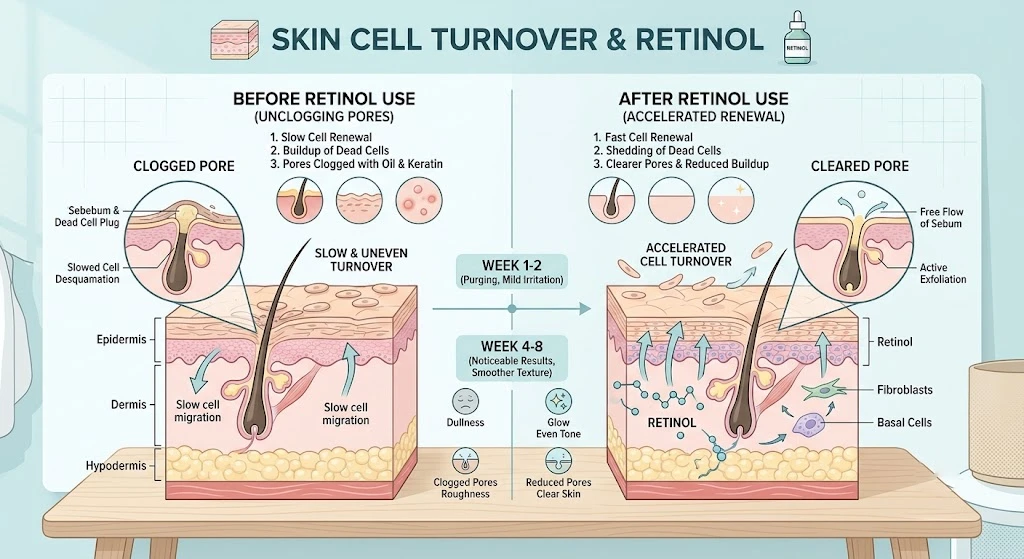
Retinol is a vitamin A derivative that works by speeding up your skin’s natural cell turnover process. In simple terms, it pushes your skin cells to renew faster — shedding old, dead cells and generating fresh ones more quickly than usual.
This accelerated renewal is exactly what makes retinol so effective for:
- Reducing fine lines and wrinkles
- Evening out skin tone and texture
- Unclogging pores and preventing breakouts
- Fading acne scars and hyperpigmentation
But that same speed is also why early retinol use can feel chaotic. When cell turnover kicks into high gear, everything trapped deep in your pores — oil, dead skin, debris — gets pushed to the surface faster than your skin can clear it. The result? A temporary flare-up that looks a lot like new acne but is actually your skin detoxing.
Can Retinol Actually Cause Acne?
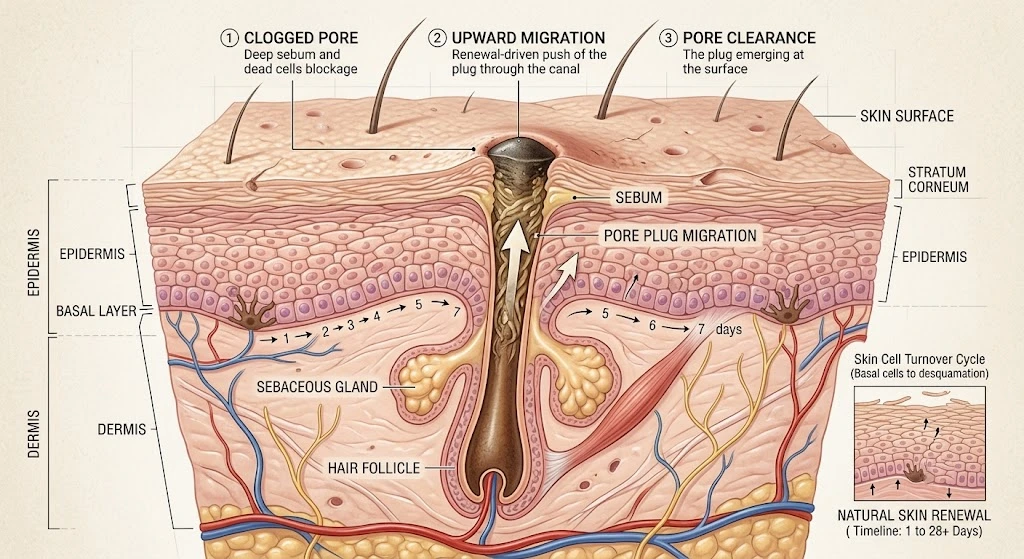
No — retinol does not directly cause acne. But it does create conditions where existing blockages become visible more quickly.
Think of it this way: those clogged pores were already there. Retinol simply fast-tracks the process of clearing them out. The pimples and whiteheads that appear in the first few weeks aren’t new acne — they’re impurities that were already sitting beneath your skin’s surface, now moving through the renewal cycle faster.
That said, it’s important to distinguish between purging and a genuine negative reaction. If you’re experiencing severe redness, burning, swelling, or breakouts in areas where you’ve never had acne before, that’s a different story — and we’ll cover how to tell the difference below.
Signs Your Skin Is Purging (Not Breaking Out)
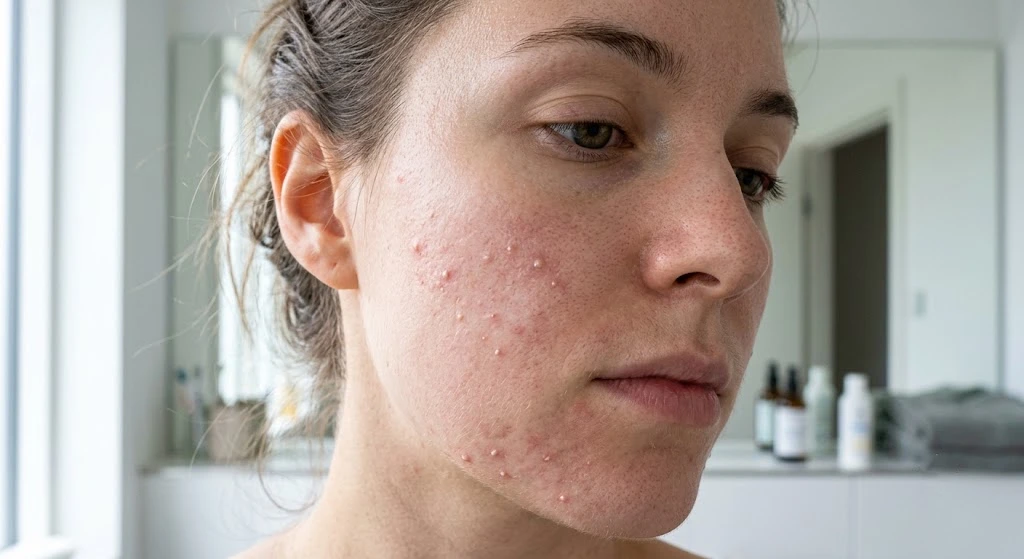
Purging has a specific pattern. Once you know what to look for, it becomes much easier to identify.
1. Small Pimples and Whiteheads
The most common sign of retinol purging is a cluster of small, mild pimples or whiteheads. These tend to appear quickly after starting retinol and are usually not the deep, painful cysts associated with hormonal or cystic acne.
2. Breakouts in Your Usual Zones
This is one of the most telling signs. Purging almost always shows up in areas where you’re already prone to breakouts — your forehead, nose, chin, cheeks, or jawline. If blemishes are suddenly appearing in places you never break out (like your neck or temples), that’s more likely an irritation response than purging.
3. Mild Redness or Sensitivity
Some redness and sensitivity during the first few weeks is normal. Your skin is working harder than usual, and it may react to products or even water more than it normally would. The key word here is mild — a little pink is fine; burning or stinging that lingers is not.
4. Dry, Flaky, or Rough Texture
As your skin sheds dead cells faster, the surface can feel drier or look slightly flaky. This is temporary and usually resolves with consistent moisturizing. It’s part of the exfoliation process, not a sign that retinol is damaging your skin.
5. Symptoms That Improve Over Time
Purging follows a curve. It typically peaks in the first two to three weeks and then gradually improves. If your skin is getting progressively worse with no signs of improvement after six to eight weeks, something else may be going on.
Purging vs. Breaking Out: How to Tell the Difference
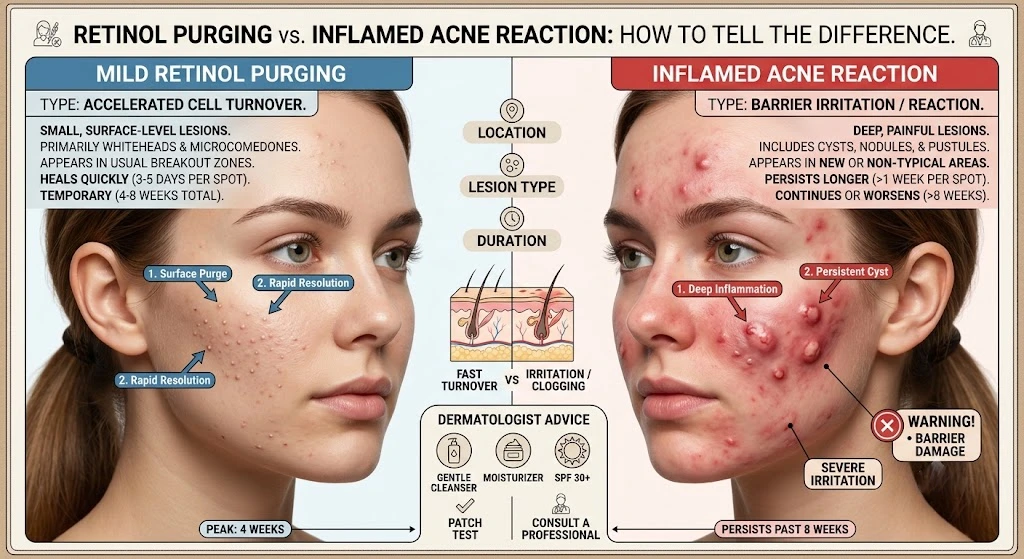
This is where most people get confused — and understandably so. Here’s a clear breakdown:
| Factor | Retinol Purging | Retinol Breakout / Reaction |
|---|---|---|
| Location | Usual acne zones (T-zone, chin, cheeks) | New areas where you don’t normally break out |
| Timeline | Starts within 1–2 weeks; improves by week 4–6 | Worsens progressively with no improvement |
| Appearance | Small pimples, whiteheads, mild flaking | Cysts, inflamed lesions, spreading redness |
| Other symptoms | Mild dryness, temporary sensitivity | Burning, stinging, persistent irritation |
| Cause | Accelerated cell turnover clearing congestion | Skin sensitivity, allergic reaction, or wrong formula |
| What to do | Continue with gentle care and moisturizer | Pause use; consult a dermatologist |
The golden rule: if it’s purging, it will follow a pattern and eventually clear. If it’s a reaction, it tends to escalate.
How Long Does Retinol Purging Last?
For most people, retinol purging lasts four to six weeks — roughly one full skin renewal cycle. This varies based on:
- Your skin type (oily skin may experience a longer or more intense purge)
- Retinol concentration (higher strengths accelerate purging but can also increase irritation)
- How often you apply it (daily use triggers faster purging than every-other-night use)
Starting slowly — two to three times per week rather than daily — can help spread out the purging phase and make it far more manageable. Think of it as easing into the process rather than forcing it.
If you’re still experiencing heavy breakouts at the eight-week mark with no signs of improvement, it’s worth pausing and speaking to a dermatologist. You may need a lower concentration, a different formulation, or an alternative ingredient altogether.
How to Manage Retinol Purging Without Damaging Your Skin
You don’t have to white-knuckle your way through the purging phase. These steps make it significantly easier:
Start low and slow. Begin with a low concentration (0.025% to 0.05%) and use it two to three nights per week. Increase frequency gradually as your skin builds tolerance.
Layer it correctly. Apply retinol to clean, dry skin — damp skin increases absorption and can amplify irritation. Wait a few minutes after cleansing before applying.
Moisturize generously. A good moisturizer is non-negotiable during this phase. It supports your skin barrier and reduces dryness, flaking, and sensitivity. Look for hydrating ingredients like hyaluronic acid, ceramides, or niacinamide.
Try the sandwich method. Apply a light layer of moisturizer before and after your retinol to buffer the strength of the active ingredient. This is especially helpful for sensitive skin.
Wear SPF every single day. Retinol increases photosensitivity, making your skin more vulnerable to UV damage. A broad-spectrum SPF 30 or higher is essential — not optional.
Skip harsh actives. During the purging phase, avoid layering retinol with AHAs, BHAs, vitamin C, or benzoyl peroxide. Combining strong actives increases the risk of irritation without improving results.
Don’t pick or squeeze. It’s tempting, but picking at purge breakouts increases the risk of scarring and prolongs the healing process.
When Should You Stop Using Retinol?
Purging is uncomfortable but manageable. These are the signs that you should actually pause:
- Severe, widespread redness or swelling
- Burning or stinging that lasts for hours after application
- Peeling that goes beyond light flaking (raw or broken skin)
- Breakouts in completely new areas that keep spreading
- No improvement whatsoever after eight weeks
When this happens, stop retinol and focus on calming your skin. Use a gentle, fragrance-free cleanser and a barrier-repairing moisturizer for a week or two until your skin normalizes.
Once things settle, you have a few options: reintroduce retinol at a lower concentration, use it less frequently, or speak to a dermatologist about alternatives.
Bakuchiol is one of the most recommended alternatives — a plant-based ingredient that delivers similar cell-renewing benefits without the same level of irritation risk. It’s a particularly good option for sensitive or reactive skin types.
Frequently Asked Questions
Can you use retinol if you already have active acne?
Yes, and it can actually help. Retinol works on acne by unclogging pores and reducing future breakouts over time. Start with a low concentration and apply every other night to avoid overwhelming already-stressed skin.
What’s retinaldehyde, and is it faster than retinol?
Retinaldehyde (also called retinal) is one step closer to retinoic acid in the vitamin A conversion chain, which means the skin needs to do less work to activate it. It’s often cited as working significantly faster than standard retinol, with less required conversion and quicker visible results — though it can also come with more initial sensitivity.
What is the “rule of 3” for retinol?
The rule of 3 is a beginner-friendly approach: use retinol every third night, apply just a pea-sized amount, and always follow with moisturizer. This minimizes dryness and irritation while your skin builds tolerance over the first four to six weeks.
Final Thoughts
Retinol purging is real, it’s temporary, and it’s actually a sign that the ingredient is doing its job. The breakouts you see in those first few weeks aren’t new acne — they’re clogged pores clearing out faster than they would have on their own.
The key to getting through it? Patience, gentle skin care, and consistency. Don’t abandon your routine the moment your skin throws a tantrum. Give it four to six weeks, moisturize well, never skip SPF, and keep actives simple.
On the other side of the purge is the skin you started using retinol for in the first place — clearer, smoother, and healthier over the long term.
Have you gone through retinol purging? Drop your experience in the comments — your story might be exactly what someone else needs to hear to keep going.
Explore more skincare guides and beauty insights at faminaz — your go-to source for honest, expert-backed lifestyle content.