
Choosing an outfit today already feels complicated. Now picture doing it with no zippers, no stretchy fabric, and a long list of social rules to follow.
That was daily life during the Regency era, and somehow, the clothing that came out of it still looks stunning more than 200 years later. This period gave us the empire waist, the Spencer jacket, and some of the most graceful silhouettes in fashion history.
If you love Bridgerton, grew up on Jane Austen novels, or just enjoy digging into fashion history, this era has something for you. Below, you’ll learn what people actually wore, why the styles shifted so dramatically, and how Regency fashion still shows up in modern closets today.
When Was the Regency Era?
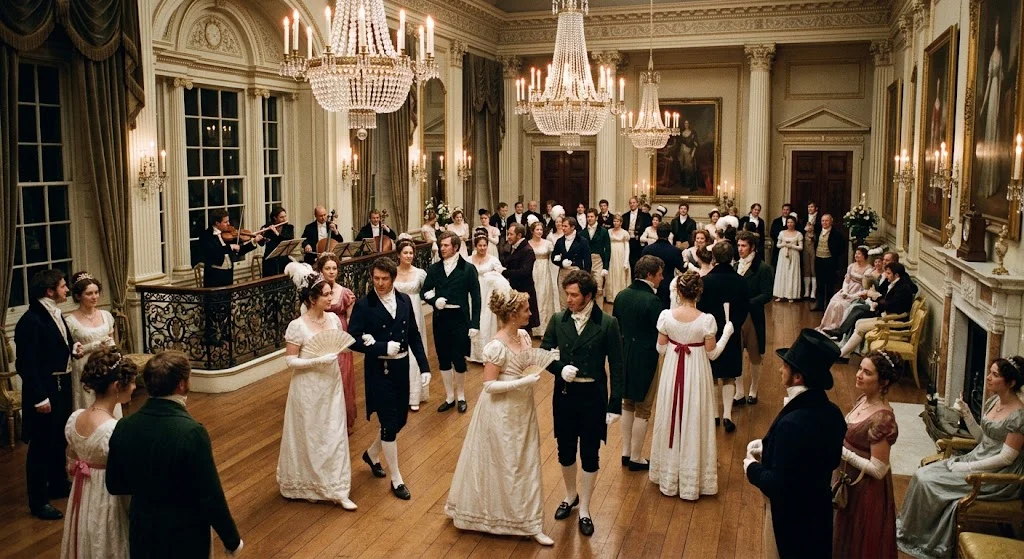
The official Regency era ran from 1811 to 1820. During this stretch, Prince George ruled Britain as Prince Regent because his father, King George III, was too unwell to govern.
But when fashion historians talk about “Regency style,” they usually mean a wider window. Most experts stretch the timeline from around 1795 to 1825 to capture the full arc of the trend.
That’s because the look didn’t start or stop on a political timeline. The signature styles began forming in the 1790s and kept evolving well past 1820.
By 1825, the classic Regency silhouette had faded into something new. Waistlines dropped back down, and skirts grew wider and more elaborate, setting the stage for the Victorian era.
What Is Regency Era Fashion?
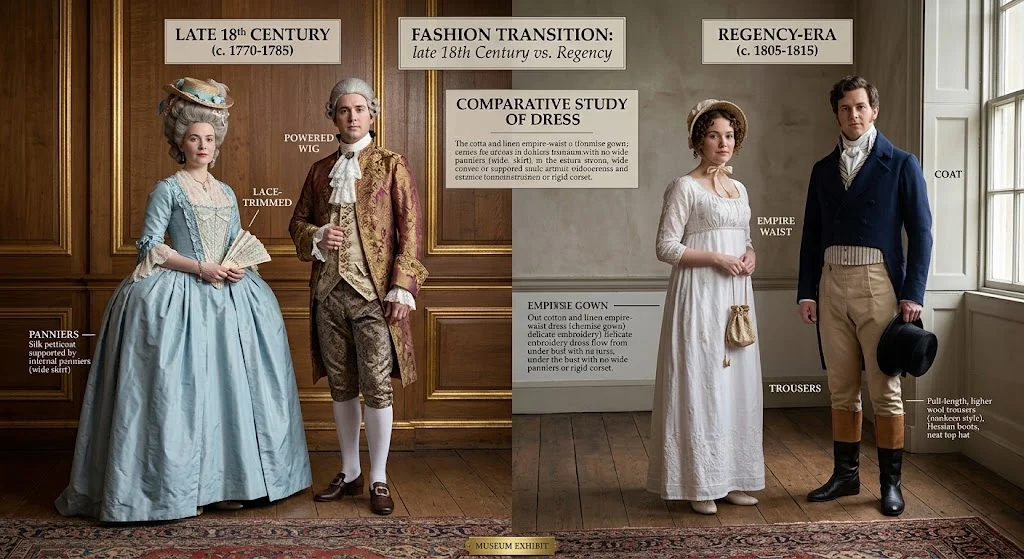
Regency fashion marked one of the sharpest style breaks in history.
Before this period, women wore tight corsets under heavy skirts held out by hoops, often using yards of thick, structured fabric. Men, meanwhile, dressed in bright colors, knee breeches, and powdered wigs.
Then everything changed.
Women’s dresses became soft, simple, and flowing. The waistline jumped up to sit right under the bust. Sleeves shrank. Necklines dropped. Fabrics turned light and airy.
Men’s fashion shifted just as much. Bold colors gave way to darker, more restrained tones. Long trousers replaced knee breeches, and the overall silhouette became slimmer and more tailored.
How Culture Shaped Regency Fashion
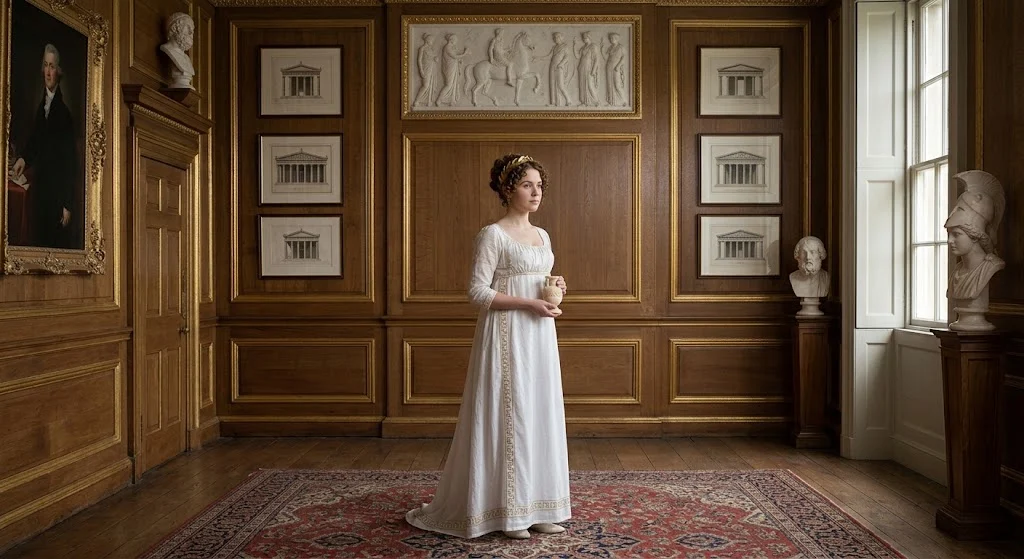
The French Revolution (1789–1799) played a huge role here. As aristocratic excess fell out of favor, fashion followed. Wide panniers, stiff corsets, powdered wigs, and fancy silk suits all started to disappear.
When Napoleon Bonaparte became Emperor in 1804, France took over as the fashion capital of Europe. His wife, Empress Josephine, quickly became a style icon, and women across the continent copied her look.
Ancient Greek and Roman art also left its mark, inspiring the high-waisted, flowing dresses that defined the era. At the same time, fashion magazines and trendsetters like Beau Brummell pushed menswear toward a cleaner, sharper fit.
The Empire Line: Regency Fashion’s Biggest Revolution
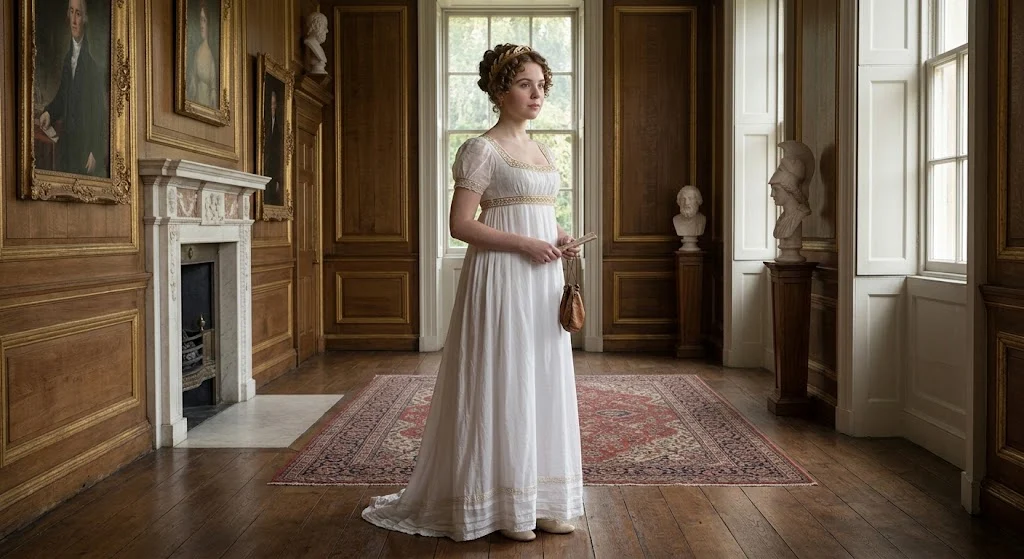
The empire line changed everything for women’s fashion. It replaced tight waists and heavy skirts with light, flowing dresses and a waistline raised just below the bust.
Here’s what made it so groundbreaking:
- The high-waist peak: The waistline reached its highest point around 1817, then slowly drifted back down toward its natural position by 1825.
- Soft fabrics, soft colors: Light muslin, silk, and fine cotton dominated the era. White was the go-to shade, with pastels reserved mostly for daytime wear.
- Modesty without sacrifice: A chemisette, a light fabric insert, filled in low necklines so women could stay fashionable and appropriately covered in public.
- Comfort finally mattered: Regency stays lifted and smoothed the body without the painful squeezing of earlier corsets, making this one of the most comfortable eras in fashion history.
The empire line remains one of the most beloved silhouettes ever created, and it’s easy to see why once you understand how much comfort it added to daily life.
Regency Women’s Fashion Essentials
A Regency woman’s wardrobe revolved around a handful of key pieces, each built to work with the era’s soft, high-waisted shape.
1. Empire Line Dresses
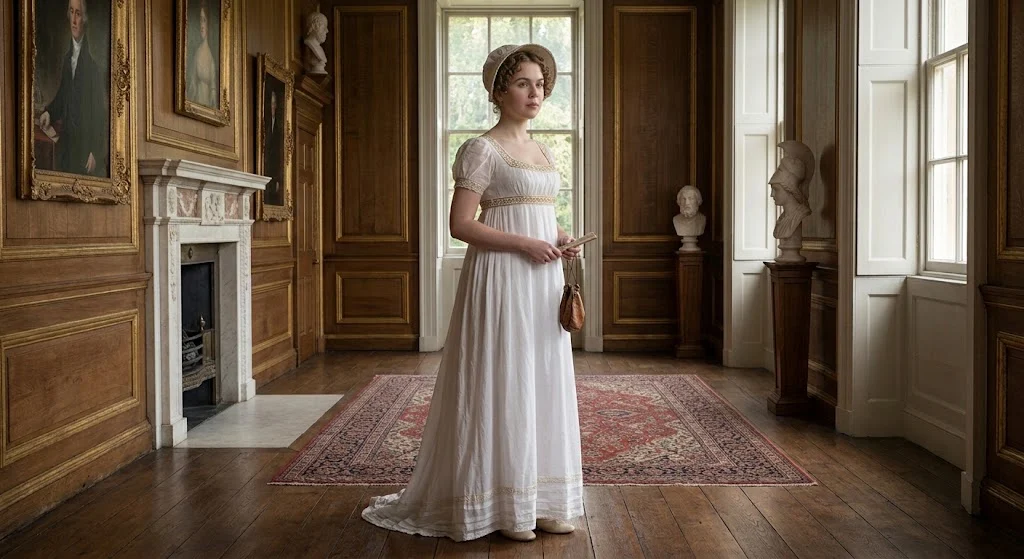
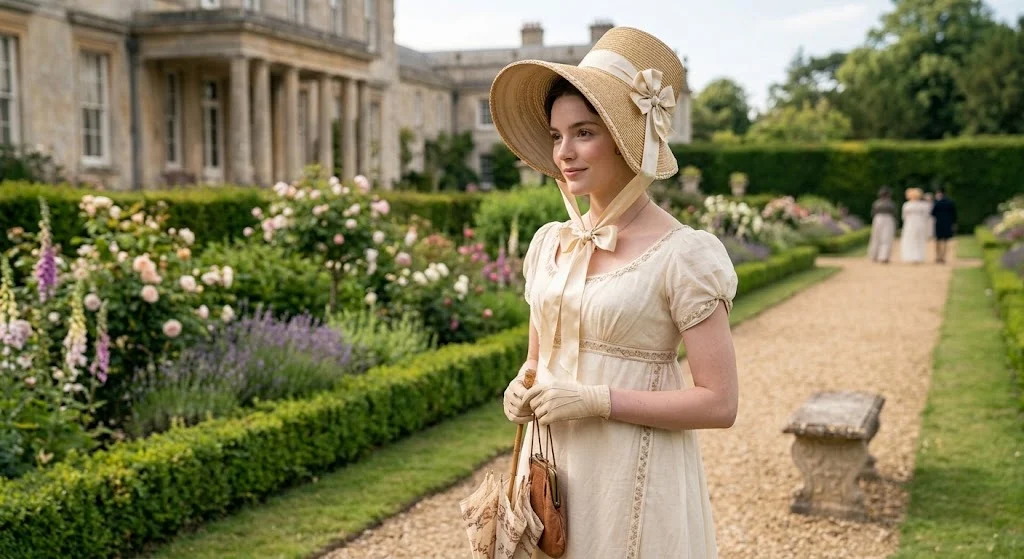
The basic dress formed the backbone of every wardrobe. It featured a high empire waist, a low neckline, short sleeves, and a skirt that fell in a straight, elegant line.
Daytime dresses used cotton or linen, while evening gowns were made from silk. Embroidery inspired by Greek and Roman patterns often decorated the hems and necklines.
2. The Pelisse Coat
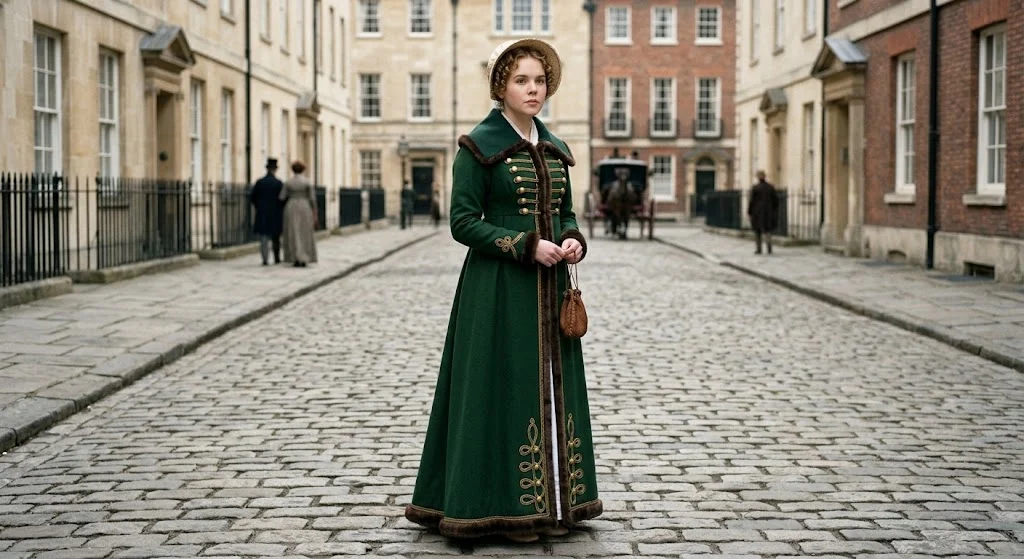
The pelisse worked as an outdoor coat, cut to follow the shape of the dress underneath it. Early versions stopped at the hip or knee, but after 1810, most became full-length.
These coats often featured wide collars, military-style buttons and braid, and fur trim. Rich colors like dark green, navy, and golden brown were especially popular.
3. The Spencer Jacket
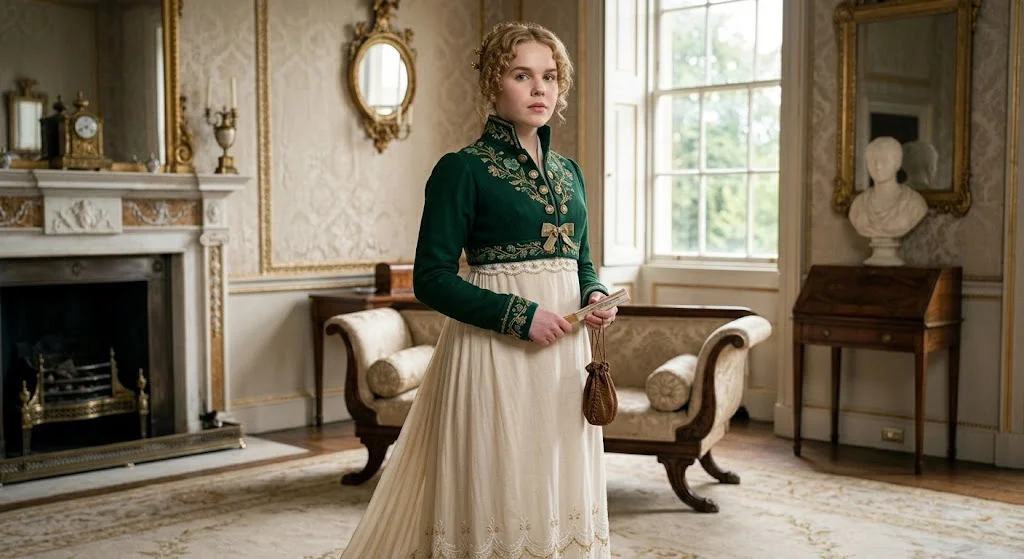
The Spencer jacket cut off just below the bust, matching the empire waistline perfectly. According to fashion legend, Earl Spencer invented the style after accidentally burning his coat tails near a fire.
Made from silk, wool, or other fine fabrics, Spencers came decorated with ribbons and embroidery, adding warmth without hiding the dress underneath.
4. The Redingote
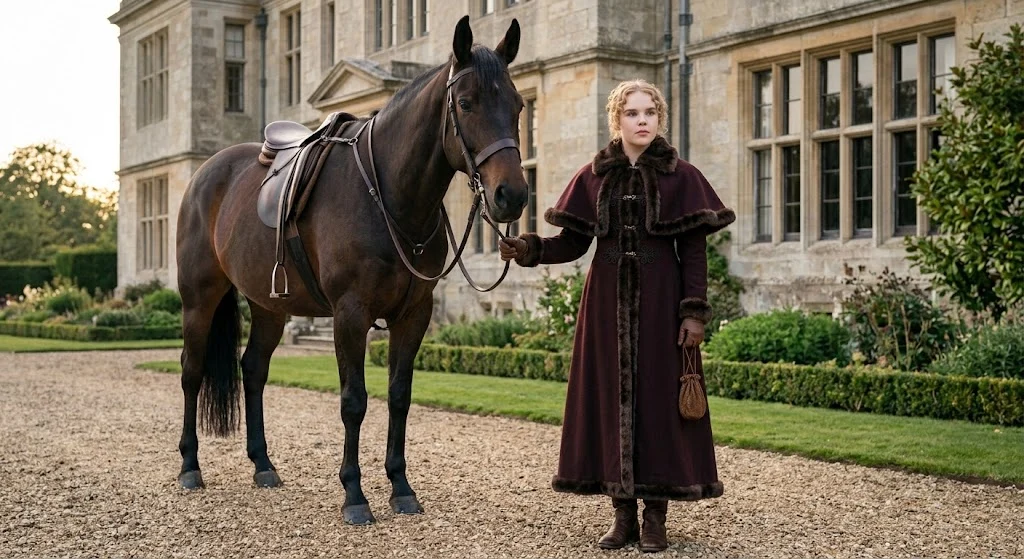
The redingote started life as a riding coat before becoming a practical travel option. Heavier than a pelisse, it often included a shoulder cape, which made it ideal for cold or rainy weather.
As dresses widened through the 1820s, redingotes grew fuller too. Most were made from heavy wool and finished with fur trim.
5. Undergarments
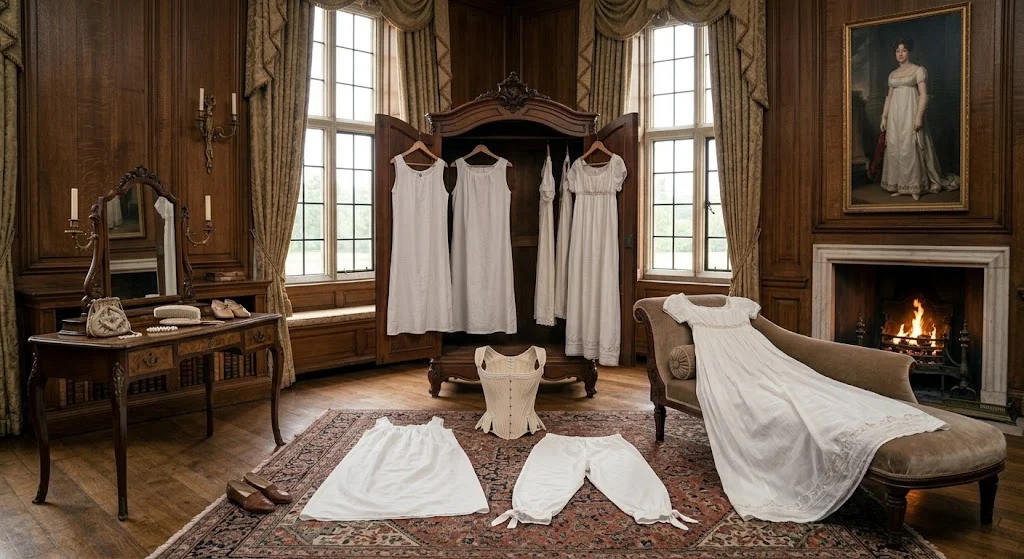
Underneath their dresses, women layered several pieces. It started with a chemise, followed by stays. Pantaloons were a newer addition; before the Regency era, women simply didn’t wear pants.
Made from flesh-toned knit fabric, these undergarments provided warmth and modesty while staying completely invisible under light, often white, dresses. Depending on the style, they reached the ankle or just below the knee.
Regency Men’s Fashion Essentials
Men’s fashion in this era leaned into understated elegance and precise tailoring, with each piece serving a clear purpose.
1. Tailcoats
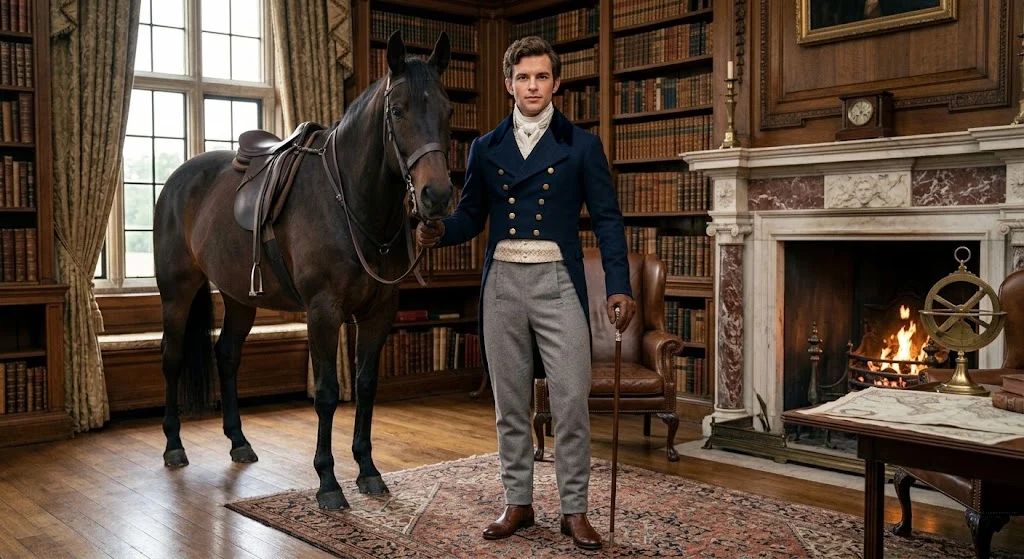
The tailcoat was the centerpiece of a man’s wardrobe. It featured a high collar, a close, fitted body, and long tails trailing at the back.
The front was cut away to show off the waistcoat underneath. Men wore a range of colors during the day but almost always switched to dark navy or black for evening events.
2. Waistcoats
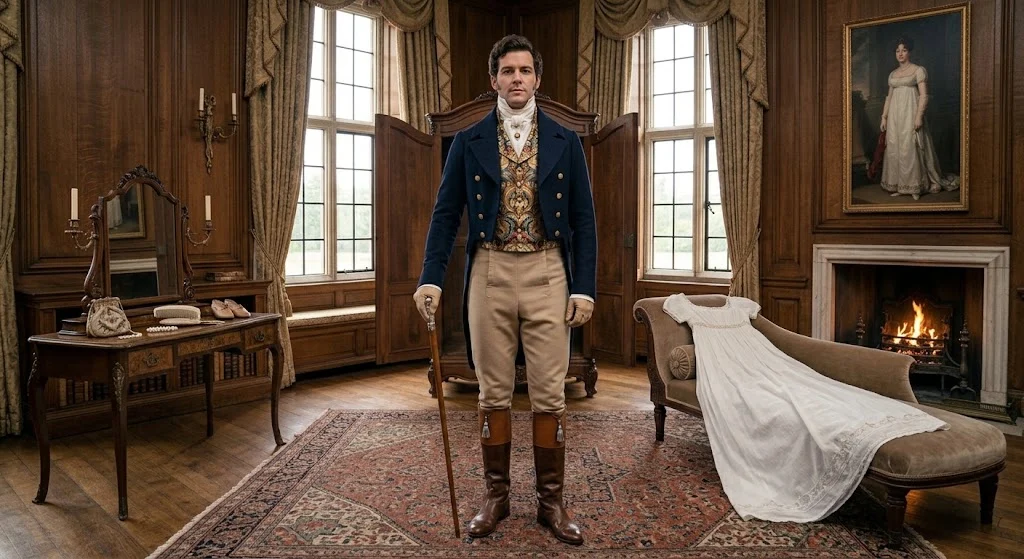
Worn under the tailcoat, the waistcoat was where men could get playful with color and pattern. Stripes, brocades, and bold prints were all fair game.
With a high collar and a length that covered the top of the trousers, the waistcoat added a pop of personality to an otherwise restrained outfit.
3. Shirts and Neckcloths
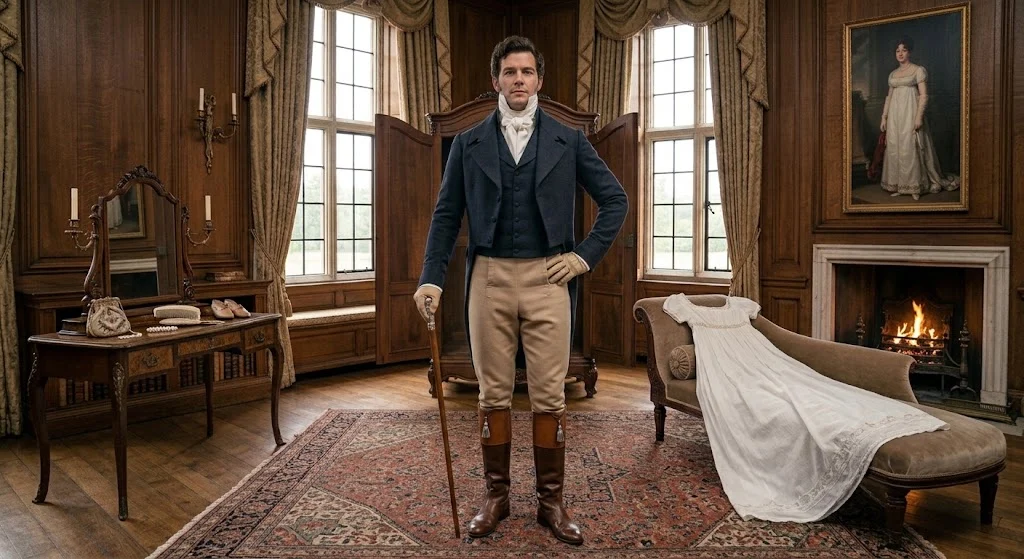
Shirts were made from white linen or cotton, with tall standing collars that reached up past the jaw. These pulled on over the head and often extended all the way to mid-thigh or the knee.
The neckcloth was a long strip of fabric wrapped around the neck and tied in a variety of styles. It quickly became the era’s most defining accessory, almost like a signature.
4. Breeches, Pantaloons, and Trousers
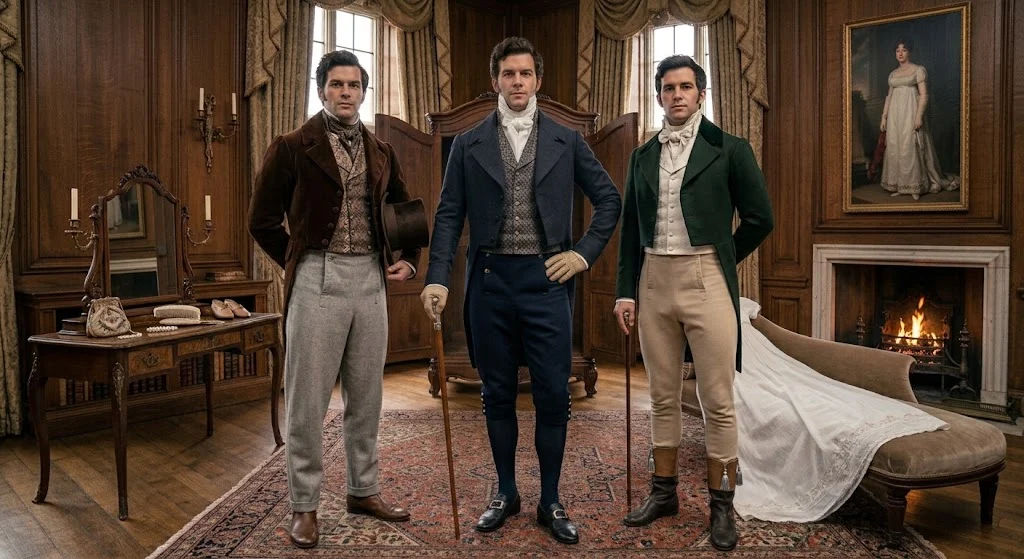
Men’s legwear changed dramatically during this period. Knee-length breeches fell out of style almost entirely, replaced by pantaloons, which fit tightly and reached the ankle or mid-calf.
Trousers were looser, sat high on the waist, and were held up with braces. They started as daytime-only wear but eventually became acceptable for evening occasions too.
5. Outerwear
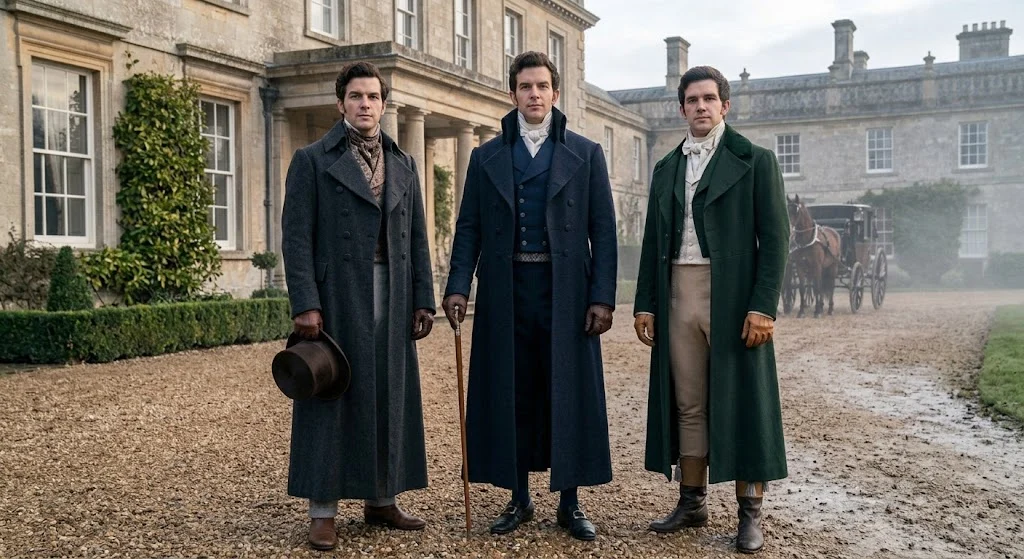
Men layered several types of coats over their tailcoats, and nearly all of them shared the same high collar and fitted shape.
Greatcoats were long and heavy, built for cold weather, while shorter coats worked better in milder temperatures. Every outer layer echoed the same tailored, structured look as the tailcoat underneath.
Accessories That Defined the Regency Look
No Regency outfit was complete without the right finishing touches, and accessories often said as much about a person’s status as their clothing did.
For Women
| Accessory | Key Features | Material | Purpose |
|---|---|---|---|
| Bonnets and Poke Bonnets | Forward-projecting brim, ribbon-tied | Straw, fabric | Sun protection, outdoor wear |
| Caps | Worn at the back of the head | Lace, fine cotton | Modesty, indoor wear |
| Reticules | Small wrist purse | Embroidered or beaded fabric | Substitute for pockets |
| Hand Muffs | Tube-shaped; bigger meant more fashionable | Fur or fabric | Hand warmth in cold weather |
| Shawls and Wraps | Kashmir shawls especially prized | Silk, wool, cashmere | Extra warmth over light dresses |
For Men
| Accessory | Key Features | Material | Purpose |
|---|---|---|---|
| Top Hats and Bicorns | High crown, narrow brim; bicorn popularized by Napoleon | Felt, beaver fur | Standard headwear, status symbol |
| Boots and Shoes | Tall boots for casual wear, low shoes for formal | Black leather | Riding, everyday, and formal wear |
| Gloves and Canes | Leather gloves, canes ranging from simple to ornate | Leather, wood | Sign of good taste and status |
| Pocket Watches | Carried on chains | Metal, gold, silver | Timekeeping and status display |
How Regency Fashion Evolved: 1800 to 1825
Regency style didn’t stay frozen in place. Over roughly 25 years, it shifted from pure classical simplicity to more decorated, structured looks.
- Classical Grecian decoration (1800–1803): Geometric patterns and Greek key designs decorated hems and necklines, staying true to the era’s ancient Greek roots.
- Egyptian ornament (1804–1807): Napoleon’s Egyptian campaigns brought exotic patterns and elaborate borders to dresses and shawls.
- Military and European influence (1808–1814): The Napoleonic Wars introduced braiding, frogging, and cord trim, while sleeves grew dramatically into the “à la mameluke” style.
- Gothic revival touches (1811 onward): Medieval-inspired details added structure, pointed Vandyke hems, and fuller sleeves as the classical line began to fade.
- The rise and fall of the waistline (1815–1825): The empire waist peaked around 1816–1817, then gradually dropped until it reached its natural position by 1825.
Regency fashion is a great example of how politics, culture, and art can shape the way an entire generation gets dressed.
Regency Fashion vs. Other Eras
| Feature | 18th Century | Regency | Victorian |
|---|---|---|---|
| Silhouette | Wide, structured, heavy | High-waisted, vertical, light | Fitted waist, full skirts |
| Structure | Rigid panniers and corsets | Softer, reduced structure | Tight corsetry returns |
| Fabrics | Heavy, layered, ornate | Lightweight, flowing | Heavier with volume |
| Overall Look | Decorative and elaborate | Simple and natural | Structured and detailed |
Why Regency Fashion Still Matters Today
Regency style never really disappeared; it just waited for the right moment to make a comeback.
Bridgerton brought empire waists and dreamy gowns back into the spotlight, introducing this elegant aesthetic to millions of new fans around the world.
Jane Austen’s novels have kept the era alive for more than two centuries, giving readers an intimate look at both the fashion and the social world behind it.
Devoted fans take things even further, attending Regency balls and historical events in full period-accurate dress. It’s proof that some styles are simply too good to leave in the past.
And the empire waist itself refuses to fade away. It keeps reappearing every few decades, from formal gowns to maternity wear, always carrying that same timeless, romantic charm.
Final Thoughts
Regency era fashion proves that great style has always been about more than just clothing. It reflects the world people lived in, the values they held, and the changes happening around them.
From the empire waist to the perfectly tailored tailcoat, every piece told a story. This era showed that simplicity and elegance can be just as powerful as excess and decoration, sometimes even more so.
The best part? Those lessons still hold up today. Clean lines, quality fabric, and thoughtful accessories never really go out of style.
Frequently Asked Questions
What fabrics were considered the most luxurious in Regency fashion?
Kashmir shawls, fine French silk, and delicate lace were the ultimate status symbols, instantly signaling social standing. Even muslin varied widely, ranging from everyday cotton to extraordinarily fine, expensive grades.
Did Regency fashion differ between the city and the countryside?
Yes. London followed seasonal trends closely, while rural areas lagged years behind and leaned toward practicality over fashion. Simpler cuts and heavier fabrics were the norm outside the capital.
How long did it actually take to get dressed in the Regency era?
Simple morning dress could be managed alone in a reasonable amount of time. Evening wear was a different story, often requiring a lady’s maid and up to two hours to get hair, undergarments, and gowns exactly right.
For more style history, celebrity fashion, and timeless trends, keep exploring faminaz.com.