, key properties, sustainability facts, and the exact care routine to keep it from shrinking or losing shape.)
You brought home a soft, flowing top that felt just like silk. After three washes, it shrank, stretched out of shape, and never looked the same again.
The tag said viscose, and that one word explains everything that happened.
Viscose is one of the most common fabrics in modern fashion, yet most shoppers have no idea how it is made, why it behaves the way it does, or how to care for it properly. It drapes like silk, costs far less than cotton, and shows up on labels from fast fashion racks to designer collections.
This guide breaks down exactly what viscose fabric is, how it is produced, the different types you will find while shopping, and the care routine that keeps it from falling apart in your closet.
What Is Viscose Fabric?
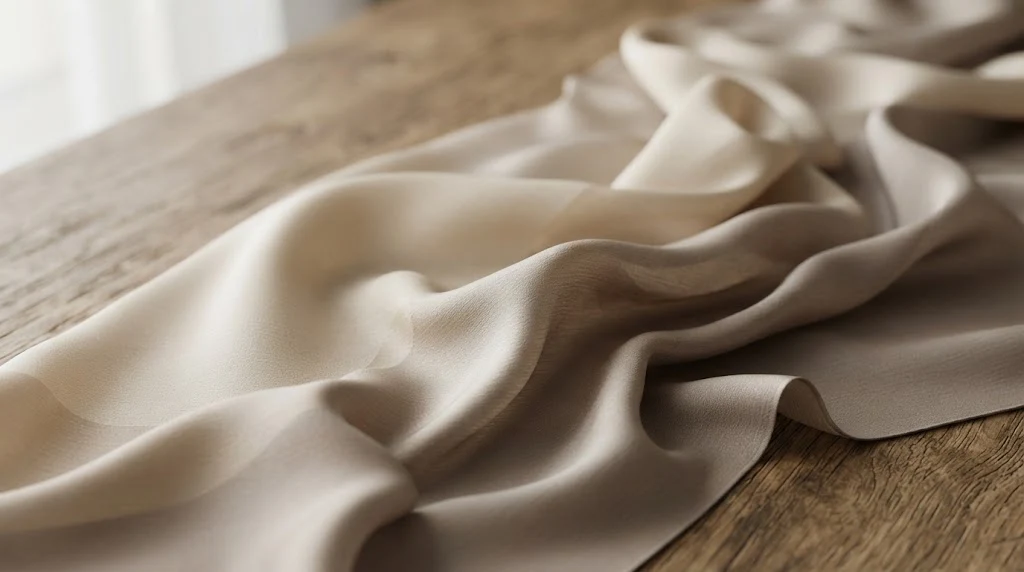
Viscose is a semi-synthetic fabric made from regenerated cellulose, usually sourced from wood pulp harvested from beech, pine, or eucalyptus trees.
It sits in a strange middle ground. The raw material is natural, but turning that wood pulp into wearable fiber requires a chemical process involving sodium hydroxide and carbon disulfide. That is why viscose is labeled semi-synthetic rather than purely natural or purely man-made.
First developed in the late 1800s as a cheaper substitute for silk, viscose earned its popularity honestly. It feels smooth and cool against skin, moves with a fluid drape, and takes dye beautifully, which is why it remains a fashion industry staple more than a century later.
Is Viscose the Same as Rayon?
Yes. Viscose is a type of rayon, and the two terms are often used interchangeably depending on where you shop.
Rayon is the umbrella category for all fabrics made from regenerated cellulose. Viscose, modal, and lyocell all fall under that umbrella as different manufacturing processes applied to the same basic raw material.
| Feature | Viscose | Rayon |
|---|---|---|
| Definition | A specific rayon-making process | The broad category covering all regenerated cellulose fabrics |
| Common label region | United Kingdom, Europe | United States |
| Same fabric on a label? | Yes | Yes |
| Care instructions | Cold wash, air dry, gentle handling | Identical, regardless of which name appears |
| Covers modal and lyocell? | No, it is one process among several | Yes, modal and lyocell are rayon variants |
If your garment tag reads viscose, rayon, or viscose rayon, treat it exactly the same way in the wash. The name does not change the fabric’s behavior.
How Is Viscose Fabric Made?
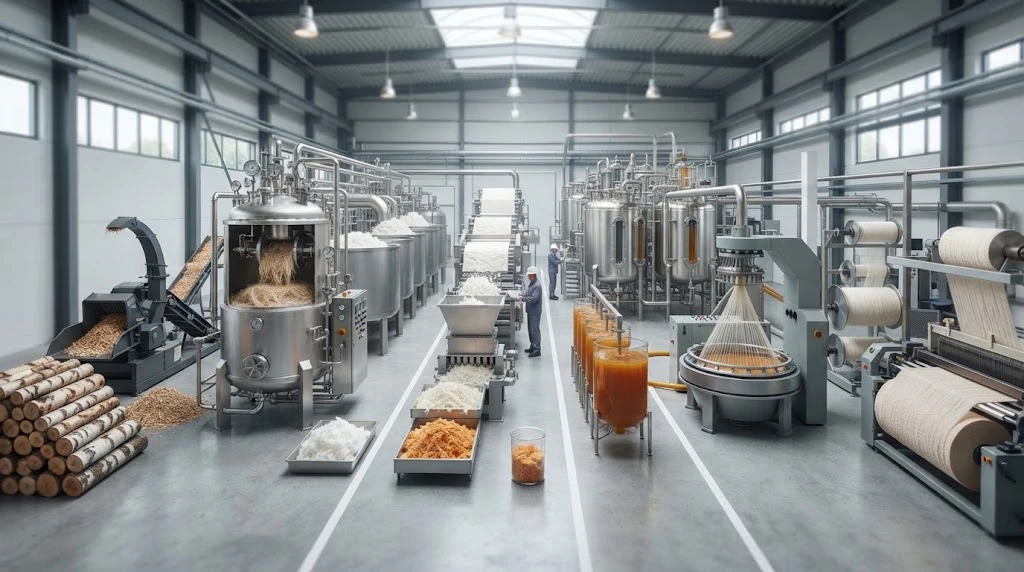
Viscose begins as a tree and ends up as a t-shirt through a multi-step chemical process. Understanding these steps explains why the fabric behaves the way it does once it reaches your closet.
- Cellulose extraction – Fast-growing trees such as beech, pine, or eucalyptus are broken down into purified wood pulp.
- Alkali treatment – The pulp is soaked in sodium hydroxide, which strips impurities and begins restructuring the cellulose at a molecular level.
- Pressing and shredding – Excess liquid is pressed out, and the material is shredded into a dry substance known as white crumb.
- Aging and xanthation – The white crumb is exposed to carbon disulfide, transforming it into a thick, honey-colored substance called yellow crumb.
- Ripening – This mixture is dissolved again in diluted sodium hydroxide and left to rest so the chemical reaction can stabilize fully.
- Filtering and extruding – The ripened liquid is filtered for purity, then pushed through a spinneret to form individual fibers.
- Acid bath – The fibers pass through a sulfuric acid bath to solidify, then get washed, stretched, and spun into finished fabric ready for weaving.
Shopping tip: Look for lyocell or Tencel on the label. These use a closed-loop process that recycles the chemical solvents instead of releasing them, making them a cleaner alternative within the viscose family.
Types of Viscose Fabric
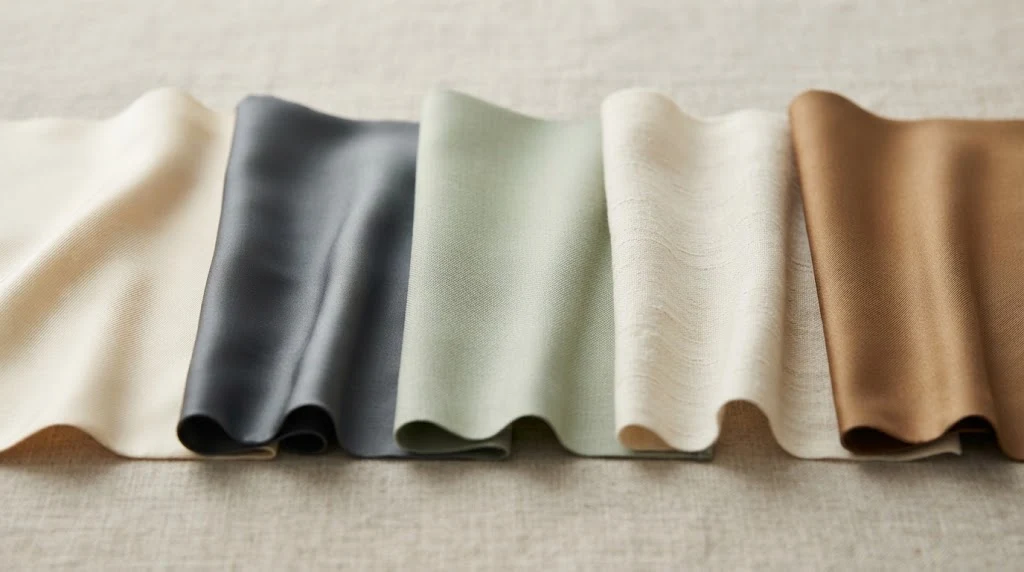
Not all viscose is created equal. The five main variants differ in raw material, processing method, and overall durability.
1. Standard Viscose This is the most widely produced form, made by dissolving wood pulp with sodium hydroxide and carbon disulfide before extruding it into fiber. It has the softest drape of the group and the lowest price point, but it weakens significantly when wet and cannot go in the dryer.
2. Modal Modal starts with beech tree cellulose but is spun under higher tension than standard viscose, producing a stronger, more elastic fiber. This processing difference makes it more resistant to shrinking and better suited to underwear, activewear, and bedding.
3. Lyocell (Tencel) Lyocell uses a closed-loop manufacturing process that reuses its chemical solvents rather than discharging them as waste. It holds up better when wet, lasts longer overall, and carries a smaller environmental footprint than standard viscose or modal. Tencel is simply the branded name for lyocell.
4. Bamboo Viscose Despite the eco-friendly marketing, bamboo viscose goes through the same chemical process as standard viscose, just starting with bamboo instead of wood. A “bamboo fabric” label does not automatically mean a cleaner product; the manufacturing process matters more than the plant source.
5. EcoVero Produced by Lenzing from certified wood sources, EcoVero uses a cleaner process that cuts water use and emissions compared to conventional viscose. It is not a closed-loop system like lyocell, but it offers better traceability and a lighter environmental impact.
Properties of Viscose Fabric
Viscose’s loosely bonded cellulose structure is responsible for both its best and worst qualities.
- Drape: Falls smoothly and moves like silk
- Breathability: Releases body heat instead of trapping it
- Moisture absorption: Pulls sweat away from skin quickly
- Softness: Smooth, cool feel with no rough texture
- Dye retention: Absorbs color deeply and evenly
- Wet strength: Loses a significant amount of durability when wet
- Wrinkle resistance: Creases easily and holds the crease
- Shrinkage risk: Prone to permanent shrinking under heat
- Abrasion resistance: Wears thin at friction points over time
The single most important property to remember is wet strength. Viscose can feel sturdy when dry, but it becomes fragile the moment it gets wet, which is exactly when most damage happens.
Is Viscose Fabric Actually Sustainable?
It is tempting to assume that because viscose comes from trees, it must be environmentally friendly. That assumption does not hold up.
The chemical conversion process, using sodium hydroxide and carbon disulfide, generates toxic waste that the plant-based origin cannot cancel out. Viscose is not automatically worse than polyester, but it is not automatically cleaner either. Both fabrics carry a real environmental cost, just through different production paths.
Sustainability comparison within the viscose family:
| Variant | Environmental Impact |
|---|---|
| Standard Viscose | Highest impact; open-loop process releases toxic solvents |
| Bamboo Viscose | No real advantage over standard viscose despite marketing |
| Modal | Slightly improved sourcing, still not closed-loop |
| EcoVero | Reduced emissions and water use, not fully closed-loop |
| Lyocell/Tencel | Lowest impact thanks to closed-loop solvent recovery |
Before you buy: A label that simply says “viscose” or “bamboo fabric” proves nothing on its own. Look for certifications like Tencel, EcoVero, FSC, or OEKO-TEX Standard 100 before trusting any sustainability claim.
How to Care for Viscose Fabric
Every viscose care rule exists for one reason: water weakens the bonds holding the fiber together. Skipping these steps is the fastest way to ruin a garment.
| Care Step | What to Do | Why It Matters |
|---|---|---|
| Washing | Use cold water only | Heat speeds up fiber breakdown |
| Handling when wet | Never wring or twist | Wet viscose is at its weakest point |
| Drying | Skip the dryer; reshape gently and lay flat or hang | Heat and tumbling cause shrinkage |
| Ironing | Use low heat with steam, inside out | The fiber surface is heat-sensitive |
| Detergent | Choose a mild formula | Harsh detergents break down cellulose fibers |
| Dry cleaning | Follow the garment label | Some pieces require solvent-based cleaning |
| Storage | Hang whenever possible | Tight folds set into permanent creases |
Pro tip: If machine washing is unavoidable, place the garment in a mesh laundry bag, select the coldest and gentlest cycle, and remove it the moment the cycle finishes.
Final Thoughts
Viscose is not a fabric you can treat the same way you treat cotton and expect it to survive. Its soft, silky feel comes with real trade-offs in durability and care.
Now that you understand what viscose fabric is made of, how it is produced, and why the care instructions are non-negotiable, you can shop with more confidence. Check the label before buying, look for Tencel, EcoVero, or FSC certification if sustainability matters to you, and always wash cold, skip the dryer, and hang to dry.
Frequently Asked Questions
Can you stretch viscose back into shape after washing?
Sometimes, if you catch it while still damp. Gentle hand reshaping can partially restore the original fit, but once the fabric dries in a distorted shape, the change usually becomes permanent.
Does viscose smell when it gets wet?
Some viscose garments give off a faint odor when wet due to leftover production chemicals. It typically fades after a few washes and is not a sign of a defective product.
Is viscose safe for sensitive skin?
Generally, yes. Its smooth surface and lack of coarse fibers make it well-tolerated. For anyone with chemical sensitivities, OEKO-TEX certified viscose is the safer choice.