
Building a conscious, functional, and long-lasting wardrobe requires looking past aesthetics and examining fiber science. For decades, synthetic materials like polyester, nylon, and acrylic dominated fast fashion due to their low production costs. However, poor breathability, heat retention, and rough micro-textures make synthetics uncomfortable for daily wear and unsuitable for sensitive skin.
As consumers look for natural alternatives, regenerated cellulose fabrics have moved to center stage. Derived from plant sources and engineered into flowing yarns, these materials bridge the gap between plant-based breathability and silk-like luxury. Among them, Tencel (lyocell) and Viscose (rayon) are the two most prominent contenders.
While garments made from both fabrics look remarkably similar on clothing racks—boasting elegant drape, featherlight softness, and a subtle luster—their internal fiber structure, manufacturing ethics, long-term durability, and biological interaction with the skin barrier are fundamentally distinct.
This comprehensive guide breaks down the full science, performance metrics, skin compatibility, and lifecycle analysis of Tencel and Viscose to help you make an informed decision for your wardrobe and personal comfort.
Understanding Regenerated Cellulose: The Science of Semi-Synthetic Fibers
To evaluate Tencel and viscose, one must first understand what regenerated cellulose is. Unlike pure natural fibers (such as raw cotton, linen, or wool) which are harvested and spun directly from the plant or animal, and synthetic fibers (such as polyester and nylon) which are synthesized from petrochemicals, regenerated cellulose lives in a distinct category known as semi-synthetics.
Cellulose is the primary structural component of plant cell walls. Trees like eucalyptus, beech, pine, and spruce, as well as fast-growing grasses like bamboo, contain abundant cellulose. However, raw wood cannot be spun directly into thread because its lignin and crystalline fiber matrices are too rigid.
In regenerated cellulose manufacturing, raw harvested wood is broken down mechanically and chemically into a thick, pulpy paste. The pure cellulose is chemically dissolved into a liquid state, forced through microscopic spinneret nozzles into a bath, and solidified back into continuous filament strands.
While the source material is 100% plant-derived and renewable, the chemical engineering required to transform wood into textile determines whether the end fabric is chemically laden or ecologically benign, mechanically weak or structurally resilient.
What Is Viscose (Rayon)?
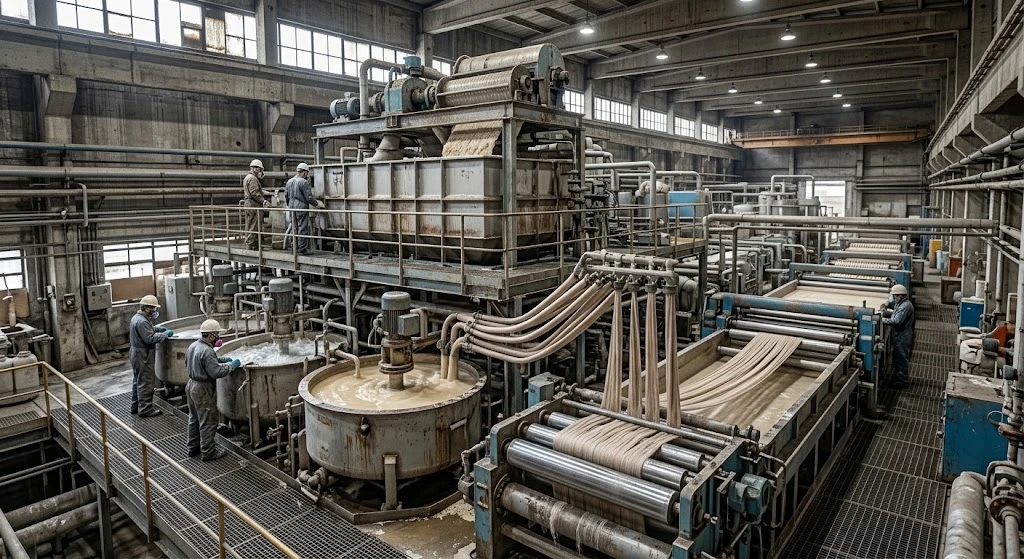
Viscose, historically designated as “artificial silk” or simply “rayon,” is the oldest commercial regenerated cellulose fiber, engineered in France during the late 1880s to provide an affordable alternative to costly mulberry silk.
The Chemical Manufacturing Workflow
The production of traditional viscose is a multi-stage, chemically aggressive industrial process:
- Pulping: Wood logs (typically sourced from pine, spruce, beech, or bamboo) are chipped, stripped of bark, and cooked in acid or alkali to isolate raw cellulose sheets.
- Alkalization: These sheets are steeped in a concentrated bath of sodium hydroxide (caustic soda) to yield alkali cellulose.
- Xanthation: The pressed alkali sheets are shredded into fine crumbs and reacted with carbon disulfide ($CS_2$) gas in pressurized reactors. This chemical transformation turns the mixture bright orange, creating sodium cellulose xanthate.
- Dissolution and Aging: The xanthate is dissolved in dilute sodium hydroxide, yielding an amber, honey-like viscous fluid (giving viscose its name). This solution is filtered, de-aerated, and allowed to age to reach optimal viscosity.
- Regeneration Spinning: The viscous solution is extruded through spinnerets containing hundreds of microscopic holes directly into an acidic coagulation bath composed of sulfuric acid, sodium sulfate, and zinc sulfate. The acid neutralizes the alkali, decomposing the xanthate and instantly solidifying pure cellulose threads.
- Finishing: The newly formed filaments are washed, desulfurized, bleached, rinsed, dried, and crimped into finished yarns.
Physical and Mechanical Characteristics
- Silk-Like Fluidity: Viscose possesses one of the lowest bending stiffness ratings among commercial apparel fibers, creating an effortless, water-like drape that falls cleanly along natural body contours.
- High Hydrophilicity: Cellulose contains thousands of exposed hydroxyl ($-OH$) groups per polymer chain. Because viscose has a high percentage of amorphous (non-crystalline) regions inside the fiber, it absorbs substantial atmospheric moisture—roughly 11% to 13% under standard humidity conditions.
- Thermal Conductivity: It feels instantly cool to the touch upon initial contact, making it a staple for warm-weather resort wear, blouses, and dresses.
What Is Tencel (Lyocell)?
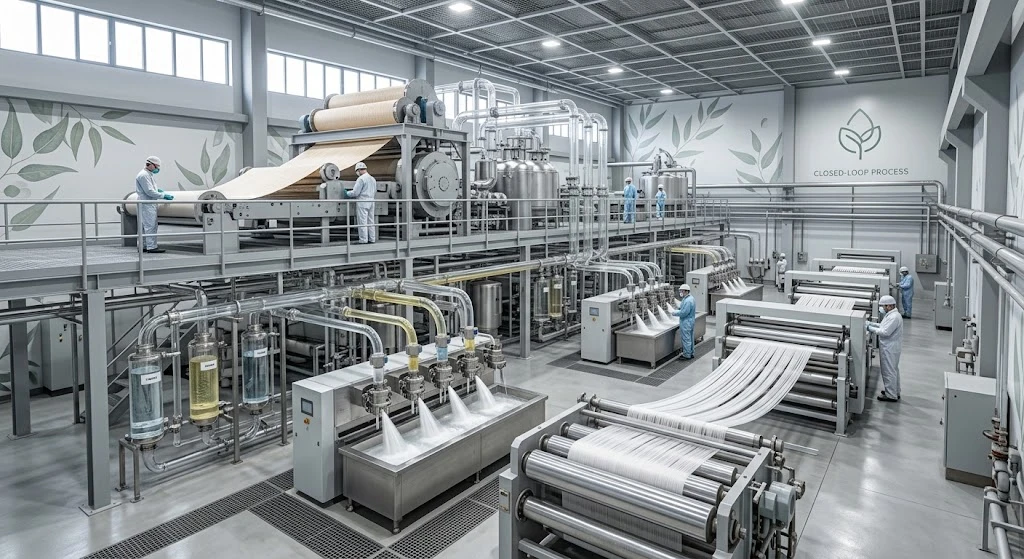
Tencel is the registered trademark name of Lenzing AG, an Austrian fiber manufacturer, representing a next-generation form of lyocell (and specialized modal) fibers developed in the 1980s and commercialized throughout the 1990s and 2000s.
While standard viscose relies on a complex sequence of chemical derivations, Tencel was engineered to simplify the manufacturing pathway using clean solvent spinning.
The Closed-Loop Lyocell Process
Tencel bypasses multi-chemical decomposition entirely, relying instead on a physical, closed-loop dissolution method:
- Certified Wood Sourcing: Lenzing sources eucalyptus, beech, and spruce trees exclusively from certified sustainably managed forests (certified by the Forest Stewardship Council – FSC, and the Programme for the Endorsement of Forest Certification – PEFC). Eucalyptus trees thrive on marginal land unsuitable for food crops, require zero artificial irrigation, and grow without chemical pesticides.
- Direct Solvent Dissolution: Dry wood pulp sheets are blended with water and an organic, non-toxic solvent: N-methylmorpholine N-oxide (NMMO). Unlike carbon disulfide, NMMO does not chemically react with or alter the molecular backbone of cellulose; it simply dissolves the hydrogen bonds holding the cellulose chains together.
- Dry-Jet Wet Spinning: The dissolved dope is forced through spinnerets into an air gap where the filaments are elongated, then into a dilute aqueous bath where the cellulose immediately precipitates out into pristine fibers.
- 5%+ Solvent Recovery: Because NMMO does not break down or bond permanently to the cellulose, over 99.5% of the solvent and process water is captured, purified, distilled, and continuously fed back into the production cycle. Residual emissions are handled in biological wastewater treatment plants.
Microscopic and Nanostructural Properties
- Nanofibril Architecture: Tencel fibers are composed of microscopic uniform nanofibrils arranged along a uniform axis. These microscopic fibrils act like miniature capillary channels, moving liquid uniformly through the interior of the fiber.
- Crystalline Alignment: Tencel has a much higher ratio of crystalline to amorphous cellulose than standard viscose. This tight molecular arrangement gives the dry and wet fiber exceptional structural integrity.
- Round Cross-Section: Under an electron microscope, individual Tencel fibers reveal a clean, smooth, circular cross-section, contrasting with the irregular, serrated edges characteristic of viscose fibers.
Head-to-Head Comparison: Physical and Technical Metrics
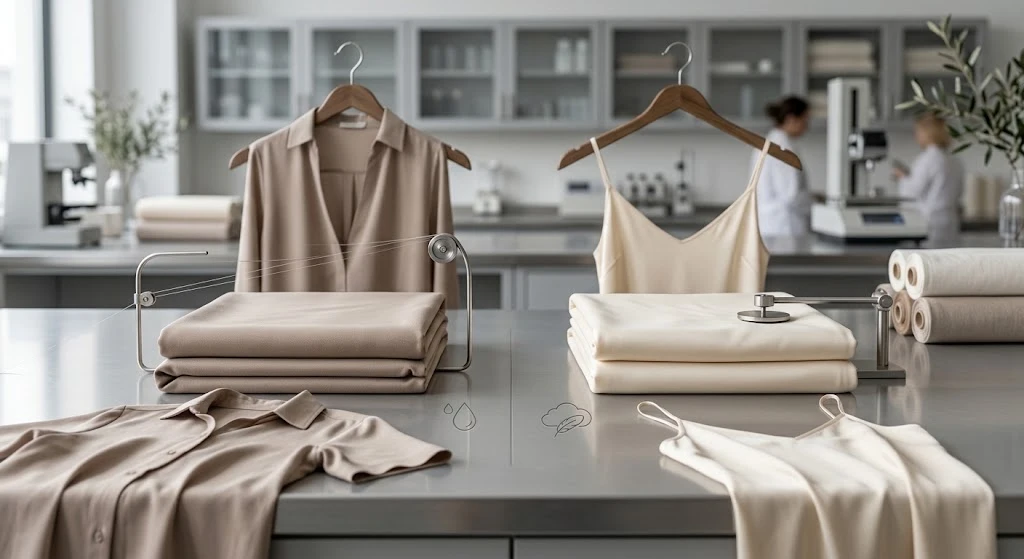
| Evaluation Metric | Tencel (Lyocell) | Traditional Viscose (Rayon) |
| Fiber Base | Certified Eucalyptus & Beech | Pine, Beech, Spruce, Bamboo |
| Solvent / Chemistry | N-Methylmorpholine N-oxide (NMMO) | Carbon Disulfide & Sodium Hydroxide |
| Spinning System | Closed-loop (99.5%+ solvent recycled) | Open chemical coagulation bath |
| Microscopic Cross-Section | Smooth, round, uniform | Lobed, crenulated, jagged edges |
| Dry Tenacity (Strength) | 38 – 42 cN/tex | 20 – 24 cN/tex |
| Wet Tenacity (Strength) | 32 – 36 cN/tex | 10 – 12 cN/tex (Drops by ~50%) |
| Moisture Absorption Rate | 11.5% (Rapid absorption & release) | 13% (High absorption, slow dry time) |
| Fiber Friction Coefficient | Extremely low ($\approx 0.1$) | Moderate ($\approx 0.3 – 0.4$) |
| Laundering Care | Machine wash gentle (Cold) | Hand wash or Dry Clean Only |
| Wrinkle Proneness | Low to moderate | High (Deep creases easily) |
| Pilling Tendency | Low to moderate (Controlled finishes) | High over multiple wash cycles |
| Biodegradability | Fully biodegradable (Marine & Soil) | Biodegradable (Slower if treated) |
| Average Retail Cost | Mid-to-luxury tier | Budget-to-mid tier |
Skin Health & Dermatological Compatibility
For individuals living with eczema (atopic dermatitis), psoriasis, sensory processing issues, or hyper-reactive skin, fabric selection directly affects comfort and symptom flare-ups.
1. Mechanical Friction and the Skin Barrier
The human skin barrier consists of the stratum corneum—a protective layer of corneocytes held together by lipids. When the barrier is inflamed or cracked, rough clothing fibers catch on delicate surface layers, causing micro-abrasions, inflammation, and itchiness.
- Viscose: Because traditional viscose precipitates inside a sulfuric acid bath, its outer surface hardens unevenly, producing a striated, jagged microscopic profile. At macro scale the garment feels soft, but at the cellular level these striations rub against irritated skin, exacerbating flare-ups during repetitive motion.
- Tencel: The dry-jet wet spinning mechanism produces a completely smooth, circular fiber with no sharp irregularities. Dermatological trials demonstrate that Tencel exhibits an exceptionally low friction coefficient. It glides across broken, dry, or hypersensitive skin with minimal physical dragging, protecting the fragile lipid barrier.
2. Microclimate Regulation and Moisture Flux
Human skin naturally transpires moisture continuously (transepidermal water loss). If sweat becomes trapped between clothing and the skin, two problems arise: epidermal maceration (weakening of the skin barrier through over-hydration) and fungal/bacterial colonization.
- Viscose: While viscose absorbs liquid quickly, its disorganized internal amorphous structure holds moisture tightly inside the swollen fiber core. As a result, when you sweat in a viscose garment, the fabric dampens and clings to the body, taking a long time to dry.
- Tencel: Tencel relies on its internal system of microscopic nanofibrils. Moisture is wicked away from the skin surface and directed through these sub-microscopic channels into the fiber core, where it disperses evenly and evaporates quickly into the surrounding air. The skin microclimate stays dry and cool, preventing prickly heat and sweat-induced dermatitis.
3. Bacterial Growth Inhibition
A study conducted by the Medical University of Innsbruck analyzed bacterial growth on synthetic, animal, and regenerated cellulose fabrics after physical exertion:
- Synthetic fibers like polyester showed extreme bacterial growth ($10^5$ colony forming units) because moisture sits on the hydrophobic plastic surfaces, incubating odor-causing bacteria such as Staphylococcus epidermidis and Corynebacterium.
- Viscose supported low-to-moderate bacterial multiplication due to sustained dampness.
- Tencel demonstrated the lowest bacterial growth rate among all tested textiles, naturally and without chemical antimicrobial additives. Its swift moisture transport leaves no damp film on the fiber exterior, depriving bacteria of the water needed to replicate.
4. Chemical Residues and Allergenic Triggers
Standard viscose processing uses zinc sulfate, carbon disulfide, and chlorine bleach compounds. While modern textile plants wash fibers thoroughly before processing them into yarn, budget fast-fashion viscose items can retain trace chemical residues, sulfur salts, or heavy metal fixatives within the yarn core. These residues can cause allergic contact dermatitis when exposed to sweat.
Tencel is processed with an organic amine oxide solvent (NMMO) that is systematically washed and recovered. The finished yarn is certified according to OEKO-TEX Standard 100 Class 1 (safe for direct contact with infant skin) and carries EU Ecolabel verification. It contains no hazardous sulfur derivatives, minimizing allergic reactions.
Durability, Structural Stability, and Everyday Laundering
A garment’s true cost and value are determined by how well it maintains its structural shape, color, and texture over multiple wash cycles.
The Wet Strength Dilemma
The most critical physical difference between viscose and Tencel lies in wet tensile strength:
When cellulose absorbs water, water molecules slide between the polymer chains, breaking inter-molecular hydrogen bonds and causing the fiber to swell.
- The Problem with Viscose: In traditional viscose, the cellulose polymer chains are short and randomly oriented. When wet, the fabric loses up to 50% of its mechanical strength. If a wet viscose garment is agitated vigorously inside a washing machine drum, the fragile fibers stretch, twist, or snap. This manifests as warped seams, puckered hemlines, and permanent shrinkage. As a result, the vast majority of premium viscose garments carry a strict “Dry Clean Only” label.
- The Strength of Tencel: Because Tencel features long-chain cellulose polymers with crystalline alignment, it maintains over 80% to 85% of its structural tensile strength when soaked in water. Tencel garments withstand standard delicate machine washing cycles without tearing, warping out of square, or losing shape.
Creasing and Wrinkle Recovery
Viscose has poor elastic recovery. When its amorphous chains are compressed during sitting, packing, or washing, they remain locked in place until heat and steam reset them. Viscose garments require regular low-heat steaming to remain presentable.
Tencel exhibits a higher elastic modulus and superior spring-back behavior. While not completely wrinkle-free like chemical-coated polyester, Tencel resists hard creases and often releases superficial wrinkles simply through body heat and natural drape within 15–20 minutes of wear.
Resistance to Pilling and Abrasion
Surface pilling occurs when short, broken fiber ends tangle into small fuzz balls during daily friction (such as seatbelt contact, bag strap rubbing, or inner-thigh friction).
- Lower-grade viscose pills quickly because the weak fibers shear easily during laundering.
- Tencel yarns are engineered using longer staple fibers that resist surface abrasion. Premium Tencel Lyocell fibers are frequently singed or treated with safe eco-enzymatic finishes to ensure surface cleanliness across dozens of laundering cycles.
Environmental and Lifecycle Analysis
Modern consumers are rightly concerned with the environmental cost of their wardrobes. While both fabrics are marketed as plant-based, their environmental footprints differ substantially.
Carbon Disulfide Toxicity in Viscose Production
The primary environmental hazard of traditional viscose lies in its dependence on carbon disulfide ($CS_2$):
- Occupational Hazard: Carbon disulfide is a neurotoxic volatile chemical. Historically, factory workers exposed to $CS_2$ vapors suffered severe central nervous system disorders, peripheral neuropathies, heart disease, and strokes. While modern safety equipment minimizes direct human exposure in tightly regulated regions, substantial viscose manufacturing is offshored to developing regions with looser worker protections.
- Air and Water Pollution: Without advanced carbon capture scrubbers, the spinning process releases toxic sulfur dioxide ($SO_2$) into the air and discharges zinc salts, sulfates, and chemical effluents into local waterways, disrupting aquatic ecosystems.
- Deforestation Issues: Although tree pulp is theoretically renewable, unregulated viscose production has historically contributed to the logging of ancient rainforests and peatlands across Southeast Asia. (Notable exception: Lenzing’s EcoVero viscose, which uses responsibly sourced wood and modern emission controls to slash emissions by up to 50%).
Tencel’s Eco-Friendly Profile
Lenzing designed Tencel specifically to address these ecological shortcomings:
- Closed-Loop System: By keeping NMMO solvent recovery rates above 99.5%, industrial chemical discharge into adjacent water systems is virtually eliminated.
- Resource Conservation: Eucalyptus plantations do not compete with food crops, need no artificial pesticides, and rely largely on natural rainfall. Producing one kilogram of Tencel requires up to 80% less water than producing an equivalent quantity of conventional cotton.
- Zero Hazardous By-Products: The solvent breakdown products of NMMO are non-hazardous, and any residual trace emissions are purified through biological treatment systems.
- Full Biodegradability: At the end of its lifecycle, 100% pure untreated Tencel fabric is certified industrial, home-compostable, soil-biodegradable, and marine-biodegradable. When placed in warm, active compost, it naturally breaks down into nontoxic water, carbon dioxide, and organic biomass within 6 to 16 weeks.
Styling and Wardrobe Applications: When to Choose Which
Both fabrics have their place in everyday fashion, provided you match the material to the garment’s intended use and maintenance routine.
When to Buy Viscose:
- Floaty Occasion Wear: Viscose shines in bias-cut maxi dresses, cocktail gowns, and flowing ruffled blouses where fluid drape is the primary aesthetic requirement and the garment will only be worn occasionally.
- Budget-Conscious Fashion: If you are shopping on a strict budget, high-street viscose provides a silky look and feel without silk’s three-digit price tag.
- Delicate Silk-Blends: Blended with small percentages of genuine silk or modal, viscose produces lightweight, beautiful scarves and resort wraps that hold vibrant, complex dyes exceptionally well.
When to Choose Tencel:
- Base Layers & Loungewear: Tencel’s ultra-smooth fiber surface makes it the premier choice for undershirts, thermal tops, sleepwear, bralettes, and underwear that remain in direct, continuous contact with sensitive skin.
- Activewear and Performance Basics: Breathability, sweat-wicking nanofibrils, and odor resistance make Tencel-blend tees and leggings a natural alternative to synthetic running and yoga gear.
- Everyday Trousers and Workwear: Tailored trousers, chore coats, and structured button-downs made from Tencel lyocell retain their shape, endure friction throughout long office hours, and resist unsightly seat creasing.
- Everyday Capsule Wardrobes: For garments you intend to wear, wash, and restyle weekly, Tencel’s ability to withstand regular washing without shrinking or falling apart justifies its higher initial retail cost.
How to Wash, Dry, and Preserve Cellulose Garments
To get the longest possible lifespan out of your regenerated cellulose pieces, follow this step-by-step care routine:
[Sort by Color & Fabric Weight]
│
▼
[Invert Garments (Turn Inside Out)] ──► [Place in Mesh Laundry Bag]
│
▼
[Washing Machine: Cold Water (≤30°C) + Gentle/Delicate Cycle]
│
▼
[Mild, Enzyme-Free Liquid Detergent | No Chlorine Bleach | No Softener]
│
▼
[Skip Tumble Dryer] ──► [Gently Reshape While Damp] ──► [Flat Air Dry Away from Sun]
│
▼
[Steam on Low/Medium Heat (Avoid Direct Ironing)]
1. Water Temperature and Cycle Speed
Always wash both Tencel and viscose garments in cold water (maximum 30°C / 85°F). Warm or hot water relaxes the cellulose chains excessively, triggering sudden fabric shrinkage. Select the “Delicate,” “Hand Wash,” or “Woolens” program on your washer to minimize drum spin agitation.
2. Detergent Selection
Avoid powdered detergents, which can leave abrasive undissolved granules trapped between fine cellulose fibers. Use a gentle, pH-neutral liquid laundry detergent. Never use detergents containing chlorine bleach, strong visual brighteners, or aggressive proteolytic enzymes, which weaken cellulose bonds. Fabric softeners should also be avoided: they leave a waxy silicone coating on fibers that impedes Tencel’s natural moisture-wicking and breathability.
3. Mechanical Protection
Turn all garments inside out before washing to protect outer face finishes. Place delicate viscose pieces, camisoles, and loose-knit Tencel items inside a zippered mesh laundry bag to prevent buttons and zippers on other garments from snagging or pulling the yarns.
4. Drying Protocol
Never put 100% viscose or Tencel items in a tumble dryer. The heat and tumbling will rapidly shrink garments by one to two full sizes and cause fiber micro-fractures.
Instead, remove items promptly once the wash cycle finishes. Gently reshape seams, plackets, and collars while the fabric is damp. Lay garments flat on a clean drying rack or dry towel away from direct, harsh sunlight, which can fade dyes and make natural fibers brittle.
5. Steaming and Wrinkle Removal
Direct ironing with high heat can scorch cellulose fibers and leave permanent shiny patches across the fabric surface. The safest method to remove wrinkles is a handheld garment steamer held 1 to 2 inches away from the fabric. If you must use a standard flat iron:
- Turn the garment inside out.
- Set the temperature dial to the lowest synthetic/silk setting.
- Place a thin cotton pressing cloth between the iron and the garment.
- Avoid sliding the iron back and forth; press gently in downward motions.
The Final Verdict
When comparing Tencel and viscose, the winner depends on whether you prioritize low upfront cost or long-term performance, skin health, and sustainability.
- Viscose remains an accessible fabric that delivers great drape and a soft hand feel at an affordable price point. However, its chemically intensive production, susceptibility to moisture-induced damage, and strict laundering requirements make it less ideal for everyday use.
- Tencel (Lyocell) represents modern fiber technology at its best. Its closed-loop, non-toxic manufacturing process protects ecosystems and production workers alike. Its ultra-smooth micro-structure, moisture management, and natural bacteriostatic properties make it the superior choice for anyone with sensitive, reactive, or eczema-prone skin. While it carries a slightly higher price tag, its resilience in the wash and enduring shape retention make it a far better long-term investment for a conscious wardrobe.
Quick Summary for Shoppers:
- Choose Tencel if you want low-maintenance daily clothing, have easily irritated or sensitive skin, sweat frequently, or want certified eco-friendly manufacturing.
- Choose Viscose if you need budget-friendly special occasion wear, are willing to dry-clean or hand-wash your items, and prioritize silky drape above rugged durability.