
Navigating active ingredients in modern skincare often feels like deciphering clinical chemistry. Cosmetic formulations have shifted away from generic, one-size-fits-all creams toward targeted, single-ingredient serums designed to treat hyper-specific epidermal concerns. Among these concentrated actives, two powerhouse ingredients consistently dominate dermatological recommendations, editorial beauty columns, and vanity shelves: niacinamide and hyaluronic acid.
Both compounds promise clearer, plumper, and more youthful skin. However, their cellular mechanisms, molecular structures, and physiological targets could not be more distinct. Misunderstanding how they function—or applying them in the wrong sequence—can turn an expensive skincare routine into a recipe for product pilling, impaired barrier function, or persistent breakouts.
This comprehensive guide breaks down the science behind niacinamide and hyaluronic acid, compares their molecular performance, resolves common layering dilemmas, and outlines precise morning and evening protocols customized for every major skin profile.
Part 1: Deconstructing Niacinamide (Vitamin B3)
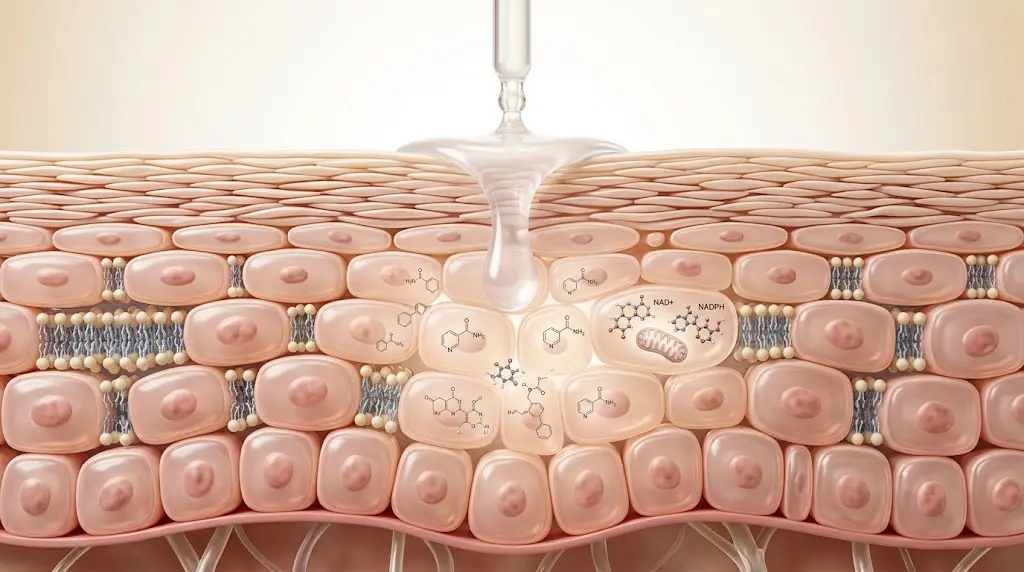
Niacinamide, chemically classified as nicotinamide, is the water-soluble, physiologically active amide form of Vitamin B3. It serves as an essential precursor to two critical coenzymes within human cellular biology: nicotinamide adenine dinucleotide (NAD+/NADH) and nicotinamide adenine dinucleotide phosphate (NADP+/NADPH).
Because human skin cells cannot synthesize or store water-soluble Vitamin B3 independently, topical application provides targeted, localized support directly to the epidermis.
┌──────────────────────────────┐
│ Topical Niacinamide │
│ (Vitamin B3) │
└──────────────┬───────────────┘
│
┌─────────────────────┴─────────────────────┐
▼ ▼
┌─────────────────────┐ ┌─────────────────────┐
│ NAD+ / NADH Pool │ │ NADP+ / NADPH Pool │
│ (Cellular Energy & │ │ (Lipid Synthesis & │
│ DNA Repair) │ │ Antioxidant Defense)│
└──────────┬──────────┘ └──────────┬──────────┘
│ │
▼ ▼
┌─────────────────────┐ ┌─────────────────────┐
│ • Collagen synthesis│ │ • Ceramide synthesis│
│ • DNA photoprotect │ │ • Sebum balance │
│ • Anti-inflammatory │ │ • Melanosome block │
└─────────────────────┘ └─────────────────────┘
1. Cellular Energy and DNA Repair
Every repair mechanism within keratinocytes (the primary skin cells) requires cellular energy in the form of ATP. NAD+ levels decline dramatically as skin undergoes chronological aging and ultraviolet (UV) radiation exposure. By replenishing this cellular coenzyme pool, topical niacinamide powers cellular repair mechanisms, promotes DNA photoprotection, and helps counteract oxidative stress caused by urban air pollution.
2. Lipid Synthesis and Epidermal Barrier Reinforcement
The outermost layer of the skin, the stratum corneum, operates like a brick-and-mortar wall. Keratinocyte cells act as the bricks, while epidermal lipids—composed primarily of ceramides, cholesterol, and free fatty acids—form the mortar. When this lipid matrix degrades, moisture escapes and environmental irritants penetrate freely.
Niacinamide directly upregulates the biochemical pathways responsible for synthesizing new ceramides, glucosylceramides, and sphingomyelin. Over 4 to 8 weeks of consistent application, it produces a denser, more resilient epidermal barrier that resists moisture loss.
3. Sebum Regulation and Pore Refinement
Unlike harsh astringents or drying alcohols that dehydrate surface oil, niacinamide modulates the lipid production rate within overactive sebaceous glands. By normalizing sebum excretion, it prevents dead cells from cementing inside the follicular infundibulum. This decongestive action reduces comedone formation and restores elasticity around the follicle walls, making enlarged, slackened pores appear visibly tighter and smoother.
4. Melanosome Transfer Inhibition
Hyperpigmentation—whether presenting as post-inflammatory erythema (PIE), post-inflammatory hyperpigmentation (PIH) from acne, or UV-induced solar lentigines—occurs when melanocytes produce excess pigment and distribute it to adjacent skin cells.
Many brightening agents work by killing melanocytes or inhibiting the tyrosinase enzyme. Niacinamide operates differently: it blocks the physical transfer of pigment packets (melanosomes) from melanocytes into surrounding keratinocytes. This mechanism makes it safe, non-toxic, and effective for treating discoloration across all Fitzpatrick skin types without causing hypopigmentation patches.
5. Anti-Inflammatory and Vascular Calming Effects
Niacinamide acts as an effective anti-inflammatory agent by suppressing the release of pro-inflammatory cytokines, including interleukin-8 (IL-8) and tumor necrosis factor-alpha (TNF-α). This makes it valuable for reactive skin conditions such as inflammatory papulopustular acne, facial rosacea, and perioral dermatitis.
Part 2: Deconstructing Hyaluronic Acid (HA)
Hyaluronic acid (HA) is a naturally occurring high-molecular-weight glycosaminoglycan distributed throughout the human body’s connective tissues, joint fluid, and ocular vitreous humor. Approximately 50% of the body’s total hyaluronic acid pool resides directly in the skin, with the highest concentration in the extracellular matrix of the dermis.
Structurally, hyaluronic acid consists of repeating disaccharide units of D-glucuronic acid and N-acetyl-D-glucosamine. Because of its dense negative charge, it functions as a biological sponge, binding up to 1,000 times its dry weight in water.
[Epidermal Surface]
│
▼
┌─────────────────────────────────────────────────────────┐
│ High-MW HA (>1,500 kDa) │ ◄── Creates protective surface film,
│ (Forms breathable film; blocks surface evaporation) │ prevents immediate TEWL
├─────────────────────────────────────────────────────────┤
│ Medium-MW HA (100 – 300 kDa) │ ◄── Hydrates mid-epidermis,
│ (Binds water within the stratum granulosum) │ plumps dehydration lines
├─────────────────────────────────────────────────────────┤
│ Low-MW / Oligo HA (<50 kDa) │ ◄── Penetrates deep tissue layers;
│ (Deep penetration; stimulates natural hyaluronan) │ signals repair pathways
└─────────────────────────────────────────────────────────┘
│
▼
[Dermal Matrix]
The Crucial Role of Molecular Weight in HA Formulations
In raw biological form, standard hyaluronic acid has a high molecular weight, typically between 1,000 and 3,000 kilodaltons (kDa). A molecule this large cannot physically squeeze through intercellular junctions to reach the dermis.
Modern cosmetic formulation breaks raw hyaluronic acid down into varying molecular fractions to target different layers of the skin:
- High-Molecular-Weight HA (>1,500 kDa): Remains resting on the skin surface. It forms an invisible, breathable viscoelastic film that binds ambient water, cushions the skin, and prevents immediate evaporation.
- Medium-Molecular-Weight HA (100 to 300 kDa): Penetrates into the middle layers of the stratum corneum, supplying immediate water reservoirs to dehydrated cells and visibly smoothing fine dehydration crinkles.
- Low-Molecular-Weight & Oligo HA (<50 kDa): Small enough to reach deeper epidermal layers. It hydrates lower cellular tiers and acts as a biological signaling molecule that encourages native collagen and hyaluronan synthesis. However, ultra-low fractions must be formulated carefully; in unbuffered, irritated environments, excessive fragments under 20 kDa can trigger transient inflammatory responses.
- Sodium Hyaluronate: The salt form of hyaluronic acid. It features a smaller molecular structure, enhanced oxidation resistance, and superior stability in water-based cosmetic solutions compared to pure free-acid HA.
The “Hyaluronic Acid Paradox” in Arid Climates
Hyaluronic acid is a pure humectant: it attracts water without discriminating where that water comes from.
- In high humidity (above 60%), HA easily draws water vapor directly from the atmosphere into the stratum corneum.
- In dry environments, air-conditioned corporate offices, or winter weather (relative humidity below 35%), there is little airborne moisture to extract. If applied to dry skin without a sealing product, hyaluronic acid reverses direction: it pulls water upward from the deeper, vascularized dermis toward the dry skin surface, where it evaporates into thin air. This accelerates transepidermal water loss (TEWL) and leaves the skin feeling tighter and drier than before.
Part 3: Head-to-Head Ingredient Comparison
Understanding their fundamental differences clarifies where each fits within an active skincare protocol:
| Metric | Niacinamide (Vitamin B3) | Hyaluronic Acid (Sodium Hyaluronate) |
| Chemical Classification | Water-soluble heterocyclic organic vitamin | Glycosaminoglycan (Complex linear polysaccharide) |
| Primary Biological Role | Coenzyme precursor (Cellular metabolism & repair) | Structural humectant (Water reservoir & biomechanical cushion) |
| Primary Target Concern | Excess oil, large pores, hyperpigmentation, redness | Dehydration, loss of bounce, fine lines, rough texture |
| Ideal Clinical Dosage | 2% to 5% (Amounts over 10% risk flushing) | 0.5% to 2% multi-molecular weight blend |
| Cellular Penetration | Readily penetrates stratum corneum to reach active cells | Depth depends entirely on molecular weight (surface vs. mid-tier) |
| Optimal Formulation pH | 5.0 to 7.0 (Stable across broad neutral spectra) | 5.5 to 7.0 (Degrades in highly acidic solutions) |
| Effect on Sebum | Modulates, reduces, and balances sebum production | Completely neutral; has no effect on sebaceous gland output |
| Best Skin Pairing | Oily, congested, rosacea-prone, uneven skin tones | All skin types, particularly dry, flaky, or tight skin |
Part 4: Can You Combine Them? Debunking Formulation Myths
A common skincare question is whether niacinamide and hyaluronic acid can be used at the same time, or if doing so deactivates one or causes severe irritation.
Myth 1: Combining Them Destabilizes Formulation pH
- The Reality: Both ingredients function best at an identical, biocompatible pH window of 0 to 7.0. Neither active is acidic enough to lower skin surface pH (unlike pure L-ascorbic acid or glycolic acid), nor are they basic enough to push the mantle into alkalinity. They sit alongside each other without chemical degradation, molecular precipitation, or pH destabilization.
Myth 2: Niacinamide Converts to Flushing Nicotinic Acid
- The Reality: Niacinamide can theoretically hydrolyze into nicotinic acid—a related compound that causes intense facial flushing, heat, and itching. However, this conversion requires prolonged exposure to extreme temperatures (above 80°C) paired with intense mineral acids over days or weeks. Storing products at normal room temperature completely eliminates this risk. Applying hyaluronic acid alongside niacinamide will not convert the vitamin into nicotinic acid.
Why They Work Better Together
Niacinamide and hyaluronic acid actually enhance each other’s performance:
- Hyaluronic acid floods the extracellular matrix with hydration, swelling keratinocytes and creating fluid, functional transport channels.
- Niacinamide uses this hydrated state to speed up the cellular synthesis of ceramides, fatty acids, and structural lipids.
- The newly produced lipid mantle seals the epidermis, preventing the water captured by hyaluronic acid from evaporating into dry indoor air.
Hyaluronic Acid Niacinamide
(Floods Hydration) (Strengthens Barrier)
│ │
▼ ▼
Keratinocytes swell Ceramides & lipids form
with stored water a tight outer matrix
│ │
└───────────────┬──────────────────┘
│
▼
Balanced, Hydrated, Resilient
Epidermal Mantle
Part 5: The Step-by-Step Layering Routine
Proper application sequence ensures your products absorb cleanly rather than sitting on top of the skin or rolling off when you apply makeup.
┌─────────────────────────────────────────────────────────────┐
│ 1. CLEANSE │
│ Gentle, non-stripping, pH 5.5 wash │
├─────────────────────────────────────────────────────────────┤
│ 2. LEAVE DAMP │
│ Lightly pat skin; do NOT dry completely │
├─────────────────────────────────────────────────────────────┤
│ 3. HYALURONIC ACID SERUM │
│ 2–3 drops pressed into damp skin │
├─────────────────────────────────────────────────────────────┤
│ 4. NIACINAMIDE SERUM │
│ 2–4 drops distributed evenly over the face │
├─────────────────────────────────────────────────────────────┤
│ 5. BARRIER MOISTURIZER │
│ Emollient or lipid-rich cream to trap humectants │
├─────────────────────────────────────────────────────────────┤
│ 6. SUN PROTECTION (AM Only) │
│ Broad-spectrum SPF 30 to 50+ applied generously │
└─────────────────────────────────────────────────────────────┘
Step 1: Cleanse with a Gentle, Non-Stripping Wash
Begin with a mild, pH-balanced (5.5) cleanser. Avoid sodium lauryl sulfate (SLS) bar soaps and harsh foamers that dissolve your skin’s natural intercellular lipids. Cleansing should wash away dirt, excess oil, and pollutants without leaving your skin feeling tight or stripped.
Step 2: Leave the Skin Damp
Do not wipe your face dry with a towel. The key to successful hyaluronic acid application is working with residual water. Leave your skin dewy, or mist it thoroughly with thermal water, rose water, or a simple hydrating botanical essence.
Step 3: Apply Hyaluronic Acid First
Apply 2 to 3 drops of your hyaluronic acid serum directly onto damp skin. Using clean fingertips, smooth and pat the fluid across your face, neck, and chest.
Applying HA directly over damp skin gives its hydrophilic chains clean water to bind to immediately, preventing the serum from pulling moisture out of deeper skin layers. Let it settle for 30 to 45 seconds until it feels slightly tacky, but not completely bone-dry.
Step 4: Apply Niacinamide
Once the hyaluronic layer is seated, dispense 2 to 4 drops of niacinamide serum onto your palm. Smooth the serum across your face, focusing on areas prone to oiliness, redness, or congestion (such as the T-zone and cheeks).
Because your skin is already hydrated, the water-soluble B3 vitamin spreads easily and absorbs deep into the stratum corneum to reach active cells.
Step 5: Lock In Moisture with a Barrier Cream
Never skip this step. Humectants trap water, but they cannot keep it there alone. You must seal that hydration with an emollient or occlusive cream containing ingredients like squalane, ceramides, shea butter, jojoba esters, or dimethicone.
This cream provides the protective lipid cap needed to stop ambient air from drawing moisture out of the hyaluronic layer.
Step 6: Daytime Defense (Sunscreen)
Every morning routine should finish with a broad-spectrum sunscreen rated SPF 30 to 50+. Niacinamide supports sun care by neutralizing free radicals, reducing UV-induced immunosuppression, and defending against deep cellular photoaging alongside your sunscreen filters.
Part 6: How to Layer with Other Common Skincare Actives
Most modern routines include other active ingredients alongside basic hydrators. Here is how to combine niacinamide and hyaluronic acid with other common skincare treatments:
┌─────────────────────────────────────────────────────────────┐
│ ACID / RETINOID STEPS │
│ │
│ Chemical Exfoliants (AHA / BHA) │
│ • Apply first to dry, cleansed skin (pH 3.0 – 4.0) │
│ • Wait 10-15 minutes for acid to neutralize │
│ │
│ Pure Vitamin C (L-Ascorbic Acid) │
│ • Apply to bare, dry skin │
│ • Wait 5 minutes, then follow with HA │
│ │
│ Retinoids (Tretinoin, Retinol, Adapalene) │
│ • Apply after HA dries, or use the “Sandwich Method”: │
│ HA ──► Niacinamide ──► Retinoid ──► Moisturizer │
└─────────────────────────────────────────────────────────────┘
1. Alpha & Beta Hydroxy Acids (AHA/BHA)
Chemical exfoliants like glycolic, lactic, and salicylic acid require a low, acidic pH environment (3.0 to 4.0) to break down dead skin cell bonds.
- How to Layer: Cleanse your face, pat it dry, and apply your AHA or BHA exfoliant first.
- Wait 10 to 15 minutes to allow the acid to complete its work and neutralize on the skin surface.
- Lightly mist your face with water, then apply your hyaluronic acid followed by your niacinamide.
- This order gives you the full benefits of chemical exfoliation while quickly soothing irritation and restoring hydration.
2. Pure Vitamin C (L-Ascorbic Acid)
There is an old cosmetic myth that combining Vitamin C with niacinamide cancels both out and produces extreme flushing. In modern, stable cosmetic formulations, this rarely happens. However, pure L-ascorbic acid requires a very low pH (under 3.5) to penetrate the skin barrier effectively.
- Morning Approach: If your skin is sensitive, use your L-ascorbic acid serum first on bare, dry skin. Wait five minutes for it to absorb, pat your skin with slightly damp hands, apply your hyaluronic acid to restore hydration, and finish with your daily moisturizer.
- Alternatively, split them up: use your pure Vitamin C in the morning for antioxidant defense, and save your niacinamide for your evening barrier repair routine.
3. Retinoids (Retinol, Retinaldehyde, Tretinoin, Adapalene)
Niacinamide is one of the best ingredients to pair with prescription retinoids or over-the-counter retinol. Retinoids frequently cause flaking, irritation, and dryness during the first few weeks of use. Niacinamide counteracts these side effects by boosting your skin’s natural ceramide production and calming inflammation.
- The “Sandwich Method” for Sensitive Skin: Cleanse thoroughly, apply hyaluronic acid onto damp skin, and smooth on your niacinamide serum. Wait three to five minutes until the skin surface is dry, then apply your pea-sized amount of retinoid. Finish with your regular night cream.
- This order hydrates and buffers the skin, lowering irritation without reducing the retinoid’s cellular benefits.
Part 7: Routines Tailored to Specific Skin Profiles
Skincare works best when tailored to your specific skin type and environment:
┌───────────────────────────────────────────────────────────────────────────┐
│ SKIN PROFILE PROTOCOLS │
├──────────────────────┬────────────────────────────────────────────────────┤
│ OILY / CONGESTED │ Focus: Sebum control, pore clearing, light texture │
│ │ AM: Salicylic wash ──► Niacinamide 4% ──► Gel SPF │
│ │ PM: Double cleanse ──► HA ──► Niacinamide ──► Gel │
├──────────────────────┼────────────────────────────────────────────────────┤
│ DRY / DEHYDRATED │ Focus: Deep hydration, barrier lipids, rich cream │
│ │ AM: Splash water ──► HA ──► Niacinamide ──► Cream │
│ │ PM: Milk cleanse ──► HA ──► Barrier cream + Oil │
├──────────────────────┼────────────────────────────────────────────────────┤
│ ACNE-PRONE / PIH │ Focus: Melanosome blocking, gentle anti-redness │
│ │ AM: Gentle wash ──► HA ──► Niacinamide ──► SPF 50 │
│ │ PM: Cleanse ──► Niacinamide ──► Retinoid ──► Cream │
├──────────────────────┼────────────────────────────────────────────────────┤
│ MATURE / AGING │ Focus: Collagen support, plumping, hydration │
│ │ AM: Peptides + HA ──► Niacinamide ──► Rich SPF │
│ │ PM: Cleanse ──► HA ──► Niacinamide ──► Tretinoin │
└──────────────────────┴────────────────────────────────────────────────────┘
1. Oily and Congested Skin
- Core Goal: Minimize pore buildup, control midday shine, and maintain healthy hydration without heavy, pore-clogging layers.
- Morning:
- Purifying gel cleanser (featuring 0.5% to 2% salicylic acid).
- Niacinamide serum (3% to 5% concentration formulated with zinc PCA to target excess sebum).
- Ultra-lightweight, oil-free water-gel hydrator.
- Mattifying, broad-spectrum chemical fluid sunscreen (SPF 40+).
- Evening:
- Gentle cleansing oil to break down daily sunscreen and sebum, followed by a light foaming wash.
- Multi-weight hyaluronic acid serum applied over damp skin.
- Niacinamide serum applied across the T-zone and cheeks.
- Lightweight, non-comedogenic gel-cream containing ceramides and green tea extract.
2. Dry, Parched, and Compromised Skin
- Core Goal: Restore depleted lipid reserves, heal flaking areas, and prevent moisture from evaporating into dry indoor air.
- Morning:
- Lukewarm water rinse or a non-foaming cleansing lotion.
- Thermal spring water mist liberally sprayed across the entire face.
- High-molecular-weight hyaluronic acid serum pressed into damp skin.
- 2% to 3% niacinamide serum to stimulate natural ceramide production.
- Rich lipid barrier repair cream packed with squalane, shea butter, and cholesterol.
- Hydrating mineral sunscreen with an SPF of 50.
- Evening:
- Cream-based makeup-removing balm, followed by a nourishing milk cleanser.
- Hydrating milky essence patted gently into the skin.
- Multi-molecular hyaluronic acid serum applied while skin remains damp.
- Niacinamide barrier restoration serum.
- Thick, restorative overnight moisture balm.
- Optional: 2 to 3 drops of pure plant squalane oil pressed over dry spots to seal in moisture.
3. Sensitive, Reactive, or Rosacea-Prone Skin
- Core Goal: Calm visible redness, lower skin surface temperature, and strengthen delicate capillary walls without stinging.
- Morning:
- Ultra-gentle, micellar water wipe or a soothing lotion wash; rinse clean with cool water.
- Soothing centella asiatica or cucumber hydrosol mist.
- Low-percentage hyaluronic acid serum free from fragrance, drying alcohol, and essential oils.
- Low-dose (2%) niacinamide serum to soothe irritation without triggering heat or flushing.
- Calming, barrier-soothing cream formulated with colloidal oat and bisabolol.
- 100% mineral sunscreen using non-nano zinc oxide (which naturally calms skin inflammation).
- Evening:
- Mild, fragrance-free cleansing lotion massaged gently using fingertips; rinse with cool water.
- Soothing botanical mist.
- Hyaluronic acid serum layered directly over damp skin.
- 2% niacinamide serum smoothed across areas of visible redness.
- Hypoallergenic, ceramide-rich barrier recovery cream.
Part 8: Common Skincare Mistakes to Avoid
Even with quality products, poor application habits can undermine your skin goals:
1. Using Excessively High Niacinamide Percentages (10% to 20%)
More is not always better in active skincare. The key peer-reviewed dermatological studies proving niacinamide’s benefits for sebum control, hyperpigmentation, and barrier health were conducted using 2% to 5% concentrations.
When cosmetic brands entered a concentration race by releasing 10%, 15%, and 20% formulas, clinics saw a noticeable spike in contact dermatitis, stinging, and micro-breakouts. For most people, high concentrations provide little extra benefit while substantially raising the risk of skin irritation. If your skin is sensitive, stick to formulas in the 2% to 5% range.
2. Applying Hyaluronic Acid to Completely Dry Skin
Applying hyaluronic acid to dry skin in an air-conditioned or arid room is one of the most common skincare missteps. Lacking ambient humidity to capture, the humectant draws water upward from deeper epidermal layers, where it quickly evaporates. Always mist or splash your face with clean water before applying your HA serum.
DRY CLIMATE / BONE-DRY APPLICATION VS. DAMP SKIN APPLICATION
┌──────────────────────────────────┐ ┌──────────────────────────────────┐
│ Airborne moisture is low (<30%) │ │ Water is already on the skin │
│ │ │ │
│ Water drawn OUT of deep dermis │ │ Water pulled IN and held │
│ ▲ ▲ ▲ ▲ ▲ ▲ ▲ ▲ │ │ ▼ ▼ ▼ ▼ ▼ ▼ ▼ ▼ │
│ │ │ │ │ │ │ │ │ │ │ │ │ │ │ │ │ │ │ │
│ ┌──────────────────────────────┐ │ │ ┌──────────────────────────────┐ │
│ │ Hyaluronic Acid (Dry Surface)│ │ │ │Hyaluronic Acid (Damp Surface)│ │
│ └──────────────────────────────┘ │ │ └──────────────────────────────┘ │
│ Result: Tightness, rebound TEWL │ │ Result: Plump, bouncy, hydrated │
└──────────────────────────────────┘ └──────────────────────────────────┘
3. Forgetting an Emollient or Occlusive Seal
Humectants are water binders, not water blockers. Leaving a hyaluronic acid or niacinamide serum exposed to room air without an emollient or occlusive moisturizer invites evaporation. Always seal your active serums with a moisturizer to trap hydration beneath a protective barrier.
4. Over-Aggressive Product Rubbing
Aggressively rubbing multiple serums back and forth causes modern polymer thickeners (such as xanthan gum, carbomer, and high-molecular HA) to shear, ball up, and peel off the face—a problem known as product pilling. Instead, dispense your serums onto your palms and gently press or pat them into the skin, allowing 30 to 60 seconds between layers for complete absorption.
Part 9: Frequently Asked Questions
Which product goes on first: hyaluronic acid or niacinamide?
Apply hyaluronic acid first, directly onto clean, damp skin. This allows its water-binding molecules to absorb ambient hydration immediately. Follow with your niacinamide serum, and finish with a quality moisturizer to seal everything in place.
Can I buy a single product that contains both ingredients?
Yes. Many modern cosmetic chemists combine both ingredients into a single, well-balanced serum or lightweight gel-cream. A combined product eliminates layering steps, simplifies your morning routine, and minimizes product pilling. Look for formulas featuring 2% to 5% niacinamide alongside multi-weight hyaluronic acid.
Will niacinamide cause my skin to purge?
Pure niacinamide does not accelerate your skin’s cellular turnover cycle, which means it does not cause true biological skin purging the way retinoids, glycolic acid, or salicylic acid do.
If you experience small bumps, persistent redness, or whiteheads after starting a new niacinamide serum, you are likely experiencing contact irritation. This is often caused by an unnecessarily high concentration (such as 10% or 20%), or a reaction to an inactive stabilizer, preservative, or solvent in that specific bottle.
How long does it take to see visible results?
- Hyaluronic Acid: Delivers immediate, visible results. Fine dehydration lines plump up within minutes of application, and skin texture feels softer right away.
- Niacinamide: Works on a longer biological timeline. Reductions in excess surface oil often show within 7 to 14 days. Noticeable improvements in skin texture, pore appearance, hyperpigmentation, and overall barrier strength typically require 6 to 12 weeks of consistent, twice-daily use.
Finding Your Ideal Routine
Achieving healthy, radiant skin does not require complicated, twelve-step beauty routines. By understanding the functional science of your skincare products, you can build a streamlined, effective regimen that delivers real results.
Niacinamide and hyaluronic acid are two of the most versatile, complementary ingredients available in modern skincare.
┌─────────────────────────────────────────────────────────────┐
│ THE GOLDEN FORMULA │
│ │
│ Damp Skin │
│ + │
│ Hyaluronic Acid (for deep, binding hydration) │
│ + │
│ Niacinamide (for cellular repair & barrier support) │
│ + │
│ Barrier Moisturizer (to lock everything inside) │
│ │
│ = Resilient, calm, beautifully balanced skin year-round. │
└─────────────────────────────────────────────────────────────┘
Start simply, pay close attention to your skin’s daily barrier response, and give these active compounds the time they need to support and balance your complexion.